Saturday, May 31, 2014

Next Round: Catching up with rye beers

Rye bread? I usually pass. But rye beer? Why not?

You're probably seeing beers with rye used in the brewing process more frequently these days at your favorite watering hole and beer retailer. But rye beers aren't new.

Back in 2002, Terrapin Beer Co., of Athens, Ga., won a Gold Medal for American Pale Ale with its Rye Pale Ale. Other breweries that dabble in rye include Firestone Walker Brewing Co. and its Wookey Jack Black IPA, Sierra Nevada (Ruthless Rye), Dogfish Head (Ryehoboth) and Samuel Adams (Revolutionary Rye Ale).

Brewers use rye as a way to add a new dimension to beer. Rye typically imparts a spicy flavor and injects other complexities. Here are some recent rye releases:

Boulevard Grainstorm Black Rye I.P.A. (750 ml. bottles and draft, boulevard.com). Kansas City, Mo.-based Boulevard Brewing Co. delivers a twist on a twist with this limited-edition brew. Black India Pale Ales, achieved with dark roasted malts, have been a style on the rise. Now brewers are tweaking black IPAs with a dose of rye.

Malted rye imparts a spicy crispness that makes Grainstorm eminently quaffable despite its 7.7% alcohol level. Its pleasantly bitter introduction is achieved with a blend of four types of hops (Amarillo, Bravo, Citra and Simcoe). Make sure to take a look at the label, an American folk artsy design that mashes up the beer's ingredients and the USA TODAY weather map.

Green Flash Road Warrior (12 oz. and 22 oz. bottles and draft, greenflashbrew.com). For a bit more bitterness and a bit more booze, try this seasonal Imperial IPA from San Diego's Green Flash Brewing Co.

Road Warrior pours like a reddish ale with an upfront piney aroma. Delicate and clean, the ale drinks like a beer much below its 9% ABV.

Green Flash created the beer as a tribute to its road-tested sales team, and as an alternative to summer's lawnmower beers — as with the Grainstorm, rye adds to the refreshment factor.

The Bruery Smoking Wood (22 oz. bottles, www.bruery.com). This Los ! Angeles area brewery — it's in Placentia, Calif. — takes rye beer to another level by aging a rye porter in rye whiskey barrels.

The beer pours out dark as oil, topped with a small layer of milk chocolate foam. From the outset, Smoking Wood exudes a sweet, complex flavor — and make no mistake — a boozy kick. It clocks in at 10% ABV.

In addition to vanilla expressions, a woody smokiness is evident from beachwood- and cherrywood-smoked malt. If you've already tried lower-alcohol rye beers, like Stone Brewing Co.'s Spröcketbier, a rye Kolsch, this is a nice way to take your rye research to the next level.

Next Round takes a regular look at new and recently released craft beers. If there's one on your radar, or if you have suggestions or questions, contact Mike Snider via e-mail. And follow Snider on Twitter: @MikeSnider.

Friday, May 30, 2014

3 Travel Stocks to Buy as Vacationers Pinch Pennies

Facebook Logo Twitter Logo RSS Logo Louis Navellier Popular Posts: 5 Biotech Stocks Promising Future RewardsTurn Trash To Treasure with These Hot Small Caps3 High-Yield Income Stocks Worth Every Penny Recent Posts: 3 Travel Stocks to Buy as Vacationers Pinch Pennies Turn Trash To Treasure with These Hot Small Caps These 2 Travel Stocks Have Blue Skies Ahead View All Posts

Memorial Day weekend marks the unofficial beginning of the summer travel season. Many investors are going to take this as an opportunity to jump in and blindly buy travel stocks as a theme for their portfolio.

That's a terrible idea.

We saw all sorts of articles this week suggesting you rush out to buy the hotel and recreation stocks as the season for summer fun begins. This is another one of those ideas that sounds fantastic, but the numbers tell a different story. Using Portfolio Grader to look at the travel and recreation stocks, I'm seeing discount airlines and -related stocks as strong buys among travel stocks — not the resorts and recreation stocks.

Southwest Airlines (LUV) has long been one of the favorite choices of cost-conscious travelers, and the company is having a fantastic 2014 so far. Earnings are up 87% so far this year; in the most recent quarter Southwest had year-over-year earnings growth of more than 160%. Analysts have been raising their estimates for both the rest of 2014 and 2015 as the fundamentals continue to just get better quarter after quarter. The stock is rated "A" by Portfolio Grader and is a "Strong Buy" at the current price.

Spirit Airlines (SAVE) is quickly becoming a favorite of budget travelers. Spirit is a no-frills airline that allows customer to take advantage of very low fares and then pay for any upgrades they may desire. Consumers seem to like it, as earnings are up more than 60% so far this year. The company is doing better than Wall Street was expecting and earnings estimates have been raised several times in the past month. Spirit Airlines just announced a bunch of seasonal routes for summer travel to places like Atlantic City and Myrtle Beach — that move should help drive profits all summer long. The stock is rated "A" by Portfolio Grader and remains a "Strong Buy."

5 Best Low Price Stocks To Watch For 2015

Consumers are pinching pennies when they book their travel as well. The desire to save as much as possible on air travel, hotels and vacation packages is driving sales and earnings growth at industry-leading online travel concern Priceline (PCLN). In spite of all the attention Priceline gets from Wall Street, this company continually outperforms their expectations. Priceline has posted four consecutive positive earnings surprises, and analysts recently raised estimates for the summer travel season and the rest of 2014. The stock has received an "A" grade from Portfolio Grader since January and remains a "Strong Buy" today.

Travel season is upon us, but that doesn't mean all travel stocks will move higher. Using Portfolio Grader can help you find those stocks that will see powerful profit increases from cost-conscious vacationers this summer.

Louis Navellier is a renowned growth investor. He is the editor of five investing newsletters: Blue Chip Growth, Emerging Growth, Ultimate Growth, Family Trust and Platinum Growth. His most popular service, Blue Chip Growth, has a track record of beating the market 3:1 over the last 14 years. He uses a combination of quantitative and fundamental analysis to identify market-beating stocks. Mr. Navellier has made his proven formula accessible to investors via his free, online stock rating tool, PortfolioGrader.com. Louis Navellier may hold some of the aforementioned securities in one or more of this newsletters.


Thursday, May 29, 2014

Ford issues four recalls involving 1.3M cars, SUVs

Ford issued four recalls Thursday covering 1.3 million vehicles in North America, most of them to fix a power steering defect in SUVs that have resulted in 20 reported accidents.

The biggest recall was of 915,216 Ford Escapes and its corporate sibling, the since-discontinued Mercury Mariner, from the 2008 to 2011 model years, over the steering issue. All of the compact SUVs were made at Ford's Kansas City plant and 736,407 are believed to be in the U.S., with most of the rest in Canada and Mexico.

A separate recall covered the same potential problem in the 2011 to 2013 full-size Explorer SUV made at Ford's Chicago plant. Ford says some 195,527 vehicles are involved, of which 177,747 are believed to be in the U.S.

The number of vehicles in the U.S. involved in Thurday's four recalls is just shy of the total number of vehicles in all of those issued by Ford in 2013. Last year, there were 16 recalls. This year, so far there are 11, says spokeswoman Kelli Felker.

Ford says it is aware of five accident reports involving a total of six injuries related to the defect in Escape and Mariner. On Explorer, there are reports of 15 low-speed accidents and two minor injuries.

Ford reports on both the Escape/Mariner and Explorer, the defect involves a glitch that could result in loss of power steering. The issue has been under investigation on the Escape within Ford since 2009, according to the National Highway Traffic Safety Administration filing. Canadian authorities opened an investigation in 2011. In January, Ford came up with a procedure and parts that allowed dealers to fix the problem without replacing the entire steering column.

The Escape and Mariner problem involves a torque sensor inside the steering column. On Explorer, the issue is an electrical connection in the steering gear that can cut in or out. The result is the same on all the vehicles: the system can default to manual steering mode. In other words, no power steering. Since it takes a lot of effort to turn the whe! el, a crash can result, especially at lower speeds.

The other recalls included:

•2010 to 2014 Taurus. Ford is recalling the popular sedan because a light that illuminates the license plate can corrode. If it does, it can cause a short circuit that can cause a fire. Some 196,639 Taurus sedans are covered by the recall. There have been 18 reports of fire. In one instance, a driver was hurt when they tried to smother the fire with their bare hands.

•Floor mats. Ford sold 82,576 driver's side all-weather floor mats for 2006 to 2011 Fusion sedan, Lincoln MKZ and related vehicles that potentially could jam under gas pedals. Two accidents were reported with no injuries. That's the same issue that Toyota says was at the heart of its unintended-acceleration recalls a few years ago. It recalled 3.8 million vehicles over the issue in 2009.

Contributing: James R. Healey

The Most Popular Investment in America

Best US Companies To Watch In Right Now

By Hal M. Bundrick

NEW YORK (MainStreet) Investors are constantly being pitched IPOs, alternative investments, exchange-traded funds and managed accounts. But regardless of the newest stock on the block, one investment vehicle remains the most popular of all: mutual funds.

Though long in the tooth, with a history that spans hundreds of years, mutual funds are still the preferred investment of 56.7 million American households -- nearly half (46.3%) of all households -- and represents 96 million individual investors, according to the Investment Company Institute's latest survey of U.S. investors. That is far and above the 5.7 million households that reported owning exchange-traded funds (ETFs) and the 3.8 million households who said they own closed-end funds in 2013.

But these investors seem to be taking a more conservative position since the financial crisis. Three in 10 mutual fund-owning households surveyed were willing to take "substantial" or "above-average" risk in their mutual fund holdings this year, compared with 36% in May 2008. "The dramatic stock market decline from October 2007 to March 2009 appears to still linger in investors' minds," says Sarah Holden, ICI senior director of retirement and investor research. "Nevertheless, equity mutual funds continue to be the most commonly owned type of fund, held by 86% of mutual fund-owning households." Other survey findings for 2013 include: More than twice as many U.S. households owned mutual funds through tax-deferred accounts, such as employer-sponsored retirement plans, individual retirement accounts (IRAs), and variable annuities, compared with 18.5 million owning funds in taxable accounts. Almost all investors were focused on saving for retirement, noted as one investment goal for 92% of mutual fund-owning households -- and the primary goal for nearly three-quarters of the households surveyed. Fully 56% of households owning mutual funds had incomes between $25,000 and $99,999, and two-thirds were headed by individuals between the ages of 35 and 64. Two-thirds of mutual fund investors said that fund performance was a "very" important factor influencing their views of the industry, and more than 40% cited fund performance as the most important factor. As the stock market moved upward, mutual funds' favorability among shareholders was 68% in 2013, an increase from 65% in 2012. More than nine in 10 households owning mutual funds had Internet access in 2013, with more than 80% using the Web for financial purposes. --Written by Hal M. Bundrick for MainStreet

Wednesday, May 28, 2014

3 Stocks Under $10 to Watch

DELAFIELD, Wis. (Stockpickr) -- At Stockpickr, we track daily portfolios of stocks that are the biggest percentage gainers and the biggest percentage losers.

>>5 Stocks Set to Soar on Bullish Earnings

Stocks that are making large moves like these are favorites among short-term traders because they can jump into these names and try to capture some of that massive volatility. Stocks that are making big-percentage moves either up or down are usually in play because their sector is becoming attractive or they have a major fundamental catalyst such as a recent earnings release. Sometimes stocks making big moves have been hit with an analyst upgrade or an analyst downgrade.

Regardless of the reason behind it, when a stock makes a large-percentage move, it is often just the start of a new major trend -- a trend that can lead to huge profits. If you time your trade correctly, combining technical indicators with fundamental trends, discipline and sound money management, you will be well on your way to investment success.

>>5 Rocket Stocks to Buy for Short-Week Gains

With that in mind, let's take a closer look at a several stocks under $10 that are making large moves to the upside.

Raptor Pharmaceuticals

Raptor Pharmaceuticals (RPTP), a biopharmaceutical company, focuses on developing and commercializing life-altering therapeutics that treat debilitating and often fatal diseases. This stock closed up 4.1% to $8.84 a share in Tuesday's trading session.

Tuesday's Range: $8.46-$8.85

52-Week Range: $6.69-$17.72

Tuesday's Volume: 723,000

Three-Month Average Volume: 1.05 million

From a technical perspective, RPTP spiked notably higher here back above its 50-day moving average of $8.80 with lighter-than-average volume. This spike higher on Tuesday is quickly pushing shares of RPTP within range of triggering a big breakout trade. That trade will hit if RPTP manages to take out Tuesday's intraday high of $8.85 to some more key overhead resistance levels at $9 to $9.09 with high volume.

Traders should now look for long-biased trades in RPTP as long as it's trending above Tuesday's low of $8.46 or above more near-term support at $8.30 and then once it sustains a move or close above those breakout levels with volume that hits near or above 1.05 million shares. If that breakout triggers soon, then RPTP will set up to re-test or possibly take out its next major overhead resistance levels at $10.50 to $11.50.

Onconova Therapeutics

Onconova Therapeutics (ONTX), a clinical-stage biopharmaceutical company, focuses on discovering and developing small molecule drug candidates to treat cancer. This stock closed up 6.5% to $4.87 a share in Tuesday's trading session.

Tuesday's Range: $4.58-$4.94

52-Week Range: $4.49-$31.13

Tuesday's Volume: 118,000

Three-Month Average Volume: 266,502

From a technical perspective, ONTX ripped sharply higher here right above its 52-week low of $4.49 with lighter-than-average volume. This stock has been downtrending badly for the last three months and change, with shares moving lower from hits high of $9.34 to its 52-week low of $4.49. During that downtrend, shares of ONTX have been consistently making lower highs and lower lows, which is bearish technical price action. That said, shares of ONTX are now starting to bounce off its 52-week low and it's quickly moving within range of triggering a near-term breakout trade. That trade will hit if ONTX manages to take out some near-term overhead resistance levels at $5 to $5.16 with high volume.

Traders should now look for long-biased trades in ONTX as long as it's trending above its 52-week low of $4.49 and then once it sustains a move or close above those breakout levels with volume that hits near or above 266,502 shares. If that breakout starts soon, then ONTX will set up to re-test or possibly take out its next major overhead resistance levels at $5.83 to $6.27. Any high-volume move above those levels will then give ONTX a chance to tag $7.

Halcon Resources

Halcon Resources (HK), an independent energy company, is engaged in the acquisition, production, exploration, and development of onshore oil and natural gas properties in the U.S. This stock closed up 4.6% to $5.83 a share in Tuesday's trading session.

Tuesday's Range: $5.51-$5.87

52-Week Range: $3.16-$6.44

Tuesday's Volume: 4.87 million

Three-Month Average Volume: 5.63 million

From a technical perspective, HK bounced sharply higher here right off some near-term support at $5.50 with lighter-than-average volume. This bounce higher on Tuesday is quickly pushing shares of HK within range of triggering a near-term breakout trade. That trade will hit if HK manages to take out Tuesday's intraday high of $5.87 to some more near-term overhead resistance levels at $6 to $6.04 with high volume.

Traders should now look for long-biased trades in HK as long as it's trending above Tuesday's low of $5.51 or above more near-term support levels at $5.23 to $5 and then once it sustains a move or close above those breakout levels with volume that hits near or above 5.63 million shares. If that breakout starts soon, then HK will set up to re-test or possibly take out its 52-week high of $6.44 to some more past resistance at $6.75 to $7.

To see more stocks that are making notable moves higher, check out the Stocks Under $10 Moving Higher portfolio on Stockpickr.

-- Written by Roberto Pedone in Delafield, Wis.


RELATED LINKS:


>>4 Big Stocks to Trade (or Not)

Top Transportation Stocks To Watch Right Now


>>5 Stocks Poised for Breakouts


>>5 Stocks Under $10 Set to Soar

Follow Stockpickr on Twitter and become a fan on Facebook.

At the time of publication, author had no positions in stocks mentioned.

Roberto Pedone, based out of Delafield, Wis., is an independent trader who focuses on technical analysis for small- and large-cap stocks, options, futures, commodities and currencies. Roberto studied international business at the Milwaukee School of Engineering, and he spent a year overseas studying business in Lubeck, Germany. His work has appeared on financial outlets including

CNBC.com and Forbes.com.

You can follow Pedone on Twitter at www.twitter.com/zerosum24 or @zerosum24.


Monday, May 26, 2014

Get smart and get better 401(k) returns

If ever you needed an incentive to learn more about money, this might be it. A new study shows that the more financially savvy you are, the more you'll earn on your 401(k) plan. And not just a little bit more, a whole lot more.

Using what they described as a "unique new data set" that links administrative data on investment performance and financial knowledge, researchers discovered that investors who are more financially knowledgeable earned – on a risk-adjusted basis – 1.3 percentage points more per year on their retirement plan investments than their less sophisticated counterparts.

In fact, being financially literate could help you build over the course of a 30-year working career a retirement fund some 25% larger than that of less-knowledgeable peers, according to the study, "Financial Knowledge and 401(k) Investment Performance," which was recently published as a working paper on the National Bureau of Economic Research website.

For example: If you're financially smart you might accumulate $625,000 in your 401(k) plan while those less smart about money might accumulate just $500,000, or $125,000 less.

One reason why the financially knowledgeable earn higher rates of return has to do with the makeup of their portfolios, according to the study's co-author Olivia Mitchell, a professor at the University of Pennsylvania's Wharton School and director of the Pension Research Council.

They own more stocks and can expect higher risk-adjusted returns, according to the study. In fact, the most financially knowledgeable in the study owned 11.5% more stock than their less smart peers, and that accounts for about 1 percentage point of their better returns. Money-smart 401(k) plan participants invested on average 61.4% of their retirement plan in stocks.

To be sure, all that might make sense to some investors: Stocks, though volatile, have returned on average a tad more than 9% since 1993, while low-risk money market funds, which aren't nearly as volatile as stocks, returne! d just 3% per year.

In other words, financial savvy 401(k) participants are merely taking advantage of the potential for greater returns that comes with investing a greater percentage of their retirement plan in risky assets.

The second finding from the study, however, suggests that being financially smart doesn't necessarily make you a prudent investor. According to Mitchell, the financially sophisticated select more volatile portfolios and their investments are more concentrated, as compared to their counterparts. Why is that? "Perhaps because they think they are better at predicting market outcomes," says Mitchell. "Interestingly, having 'some' knowledge is not strongly associated with most performance measures; rather it's the best-informed who are different."

Take the quiz (see below) from the study to measure your financial knowledge. Consider yourself financially knowledgeable if you answer four or five of the questions correctly.

To be fair, this isn't the first study to show that more money-smart people accumulate larger nest eggs. But it is the first to show that financially smart 401(k) plan participants earn higher risk-adjusted expected returns compared to their less sophisticated counterparts.

Another finding from the study has to do with financial education. We need more of it, and perhaps sooner rather than later in life. "It can still be socially optimal to raise financial knowledge for everyone early in life, for instance by mandating financial education in high school," says Mitchell. "This is because even if the least educated never invest again and let their knowledge endowment depreciate, they will still earn higher returns on their saving which generates a substantial welfare boost."

There's also evidence that workplace financial education can also help. For instance, Mitchell noted that people attending an employer-sponsored retirement saving seminar are more likely to contribute to their pension accounts. "There remains some concern about reve! rse causa! lity – maybe those motivated to save went to the seminars," she says. "Yet randomized controlled trials do confirm that people receiving information about the additional benefits they could get from extra pension contributions did save more."

In the absence of financial education, Mitchells says investors would be wise to follow some age-old rules of thumb, such as don't buy a house unless you have 25% of the purchase price for a down payment. And your payments for the principal and interest on mortgage plus real estate taxes shouldn't exceed 25% of your income. "All these rules of thumb went by the wayside during the run-up to the financial crisis," she says. "I think we could do well to go back to some of those (rules of thumb) quite honestly."

Mitchell also says that new 401(k) plan features, often referred to as nudges, such as auto-enrollment and auto-escalation, have helped in the absence of financial education. But it's not enough in and of itself.

"We are not hitting the targets we need to hit," she says, noting that participants in the U.S. aren't contributing on average much more than 6% of their salary to their retirement plans. "I think we ought to be contributing 25% of income to retirement plans. If you think about how much longer people are going to be living in the future and couple that with relatively low expected rates of return on the market, we're just going to have to save a lot more and work a lot longer to be able to get there."

And so what needed is more nudging as well as more financial education, especially in schools. "Maybe we should be focusing more on financial literacy than calculus two," says Mitchell.

Financial Knowledge Quiz

How many of the below questions can you answer correctly? The more you get right, the more likely your 401(k) will outperform those who are less financially savvy. (Answers are below.)

1 - Interest Rate: Suppose you had $100 in a savings account and the interest rate was 2% per year. After five years, how! much do ! you think you would have in the account if you left the money to grow?

a. More than $110

b. Exactly $110

c. Less than $110

2 - Inflation: Imagine that the interest rate on your savings account was 1% per year and inflation was 2% per year. After one year, how much would you be able to buy with the money in this account?

a. More than today

b. Exactly the same

c. Less than today

3 - Risk: Is this statement True or False? Buying a single company's stock usually provides a safer return than a stock mutual fund.

a. True

b. False

4 - Tax Offset: Assume you were in the 25% tax bracket (you pay $0.25 in tax for each dollar earned) and you contributed $100 pretax to an employer's 401(k) plan. Your take-home pay (what's in your paycheck after all taxes and other payments are taken out) will then:

a. Decline by $100

b. Decline by $75

c. Decline by $50

5 - Match: Assume that an employer matched employee contributions dollar for dollar. If the employee contributed $100 to the 401(k) plan, the account balance in the plan including that contribution would:

a. Increase by $50

b. Increase by $100

c. Increase by $200

d. Remain the same

Editor's note: The first question measures peoples' ability to do a simple interest rate calculation; the second tests peoples' understanding of inflation; and the third is a joint test of knowledge about "stocks" and "stock mutual funds" as well as risk diversification, since the correct response requires the respondent to know both what a stock is and that a mutual fund is comprised of many stocks. Source: Financial Knowledge and 401(k) Investment Performance

Answers: 1,a; 2, c; 3, b; 4, b; 5, c.

Robert Powell is editor of Retirement Weekly, a service of MarketWatch.com. Email him at rpowell@allthingsretirement.com.

Sunday, May 25, 2014

10 Best Machinery Stocks To Watch For 2015

10 Best Machinery Stocks To Watch For 2015: Deutz AG (DEZ)

DEUTZ AG is a Germany-based manufacturer of diesel engines. The Company produces engines with outputs of between 19 kilowatts (kW) and 520 kW for on-road as well as non-road applications. Its activities cover development, design, production, sales and services for diesel engines that are cooled by water, oil or air. DEUTZ AG divides its activities into two segments: DEUTZ Compact Engines and DEUTZ Customized Solutions. DEUTZ Customized Solutions segment focuses on air-cooled engines and large liquid-cooled engines with capacities of more than eight liters. The segment DEUTZ Compact Engines comprises liquid-cooled engines with capacities of less than four liters as well as engines with capacities of four to eight liters. The Company is the executive and operating company within the DEUTZ Group. It has a global reach with its production sites, ten distribution companies, nine sales offices, as well as over 800 distribution and service partners in more than 130 countries worldwi de. Advisors' Opinion:
  • [By Jonathan Morgan]

    RWE AG (RWE) jumped 6.4 percent, leading a gauge of utilities higher. Deutz AG (DEZ) plunged the most in more than two years after an investor sold a 8.4 percent stake in the manufacturer of diesel engines. ProSiebenSat.1 Media AG (PSM) dropped 1.1 percent after Telegraaf Media Groep NV sold its stake in the company.

  • source from Top Stocks Blog:http://www.topstocksblog.com/10-best-machinery-stocks-to-watch-for-2015.html

Saturday, May 24, 2014

Hackers can 'un-brick' stolen iPhones

apple phone hack

A Twitter user in Mexico shows off four iPhones that were unlocked with this hack.

NEW YORK (CNNMoney) Two hackers have figured out a way to unlock lost Apple devices -- a boon for criminals with stolen iPhones and iPads.

The hackers have discovered a method for bypassing a protective feature on Apple (AAPL, Fortune 500) devices. Lost your iPhone? No worries. Something called "Activation Lock" turns it into a useless brick by connecting to Apple servers via its iCloud service.

But a Dutch hacker going by the name AquaXetine and a Moroccan hacker with the name MerrukTechnolog have discovered a way around that.

By plugging your iPhone or iPad into a computer and altering a file inside, you trick the device into connecting to the hackers' server instead. Once connected, the server will tell the iPhone or iPad to unlock.

The process is clunky, but folks around the world are already celebrating that it works.

Related story: eBay hacked

In recent days, the hackers' Twitter pages have been filled with photos of unlocked iPhones and iPads uploaded by grateful people in Brazil, Mexico, Russia, the United States and elsewhere.

A Twitter user in China, @t_ai_ya_ki, posted photo of a liberated iPhone on his bed and wrote, "thanks bro :)" Another in Poland, Maciek Walczykowski, showed his unlocked iPhone with a hacker's Twitter feed in the background. Dozens of others did the same.

Watch a hacker steal encrypted passwords   Watch a hacker steal encrypted passwords

The hacking duo, Team DoulCi (iCloud backwards), posted instructions on its website with this caveat: This runaround is only meant to be used for good. The hack was "built with love" for those original owners who lost access to their own devices, they said. No stolen Apple devices, please.

Right. Here's a reality check: So far, most of those taking advantage of this trick are posting photos of several unlocked devices at once.

For example, someone in the Philippines using the name @esonglance showed off six unlocked iPhones. Another user, @illPaick in Mexico, showed off six iPhones and an iPad. Who accidentally locks himself out of a half dozen of his own devices? No one.

Apple did not immediately return calls for comment.

Mark Loman, a malware analyst for cyber! security company SurfRight, described the hack as a "man-in-the-middle attack." To make it work, these hackers place themselves between your device and Apple.

It's inherently unsafe. On their website, the hackers promise "more information" at midnight Thursday (EST). To top of page

Cash allowances for CEOs? They're not kids

Do CEOs need an allowance?

Scores of corporate boards believe they do, and provide executives extra pocket money that might make your kids' allowances look like chump change.

As corporate proxy season comes to an end, it's clear that many CEOs have scored big on the compensation front. They've also parlayed huge gains from company stocks and stock options, whose values have soared with the economy's rebound and Wall Street's five-year-old bull market.

Given increasing shareholder unrest and the widening compensation divide between the top rung of Corporate America and the rest of the country's labor force, many corporate boards are reining in executive perquisites ranging from personal use of corporate jets to company cars.

Yet the executive cash allowance still lines plenty of pockets. About 7% of Fortune 500 companies provide CEOs an allowance, unchanged from 2008, says compensation tracker Towers Watson. Median annual allowance: $32,000.

A USA TODAY analysis of 2013 proxy filings found large-scale allowances at a broad array of companies of up to $500,000 a year, including payouts to CEOs that seemingly need them the least.

Governance experts say allowances, some in lieu of other perks, some on top of other corporate freebies, are unwarranted. "There's little economic logic for public companies to reward top executives with perks,'' says Lucian Bebchuk, director of Harvard Law School's Program on Corporate Governance.

United Technologies — where allowances equal 5% of executive salaries — is ending them this year, joining St. Jude Medical and Charles River Laboratories, which gave CEO James Foster allowances of $90,000 in 2013 and $180,000 in 2012. Components maker TE Connectivity is also weaning execs from allowances, but offset their demise by boosting salaries 10%.

Still, there's plenty of rationale among some corporate boards not only to keep the executive allowances, but to sweeten them. Donut chain Krispy Kreme has upped CEO James Morgan's ! allowance 25% to $30,000 a year. Tobacco marketer Lorillard upped CEO Murray Kessler's annual allowance for personal use of corporate aircraft to $375,000, up 50% from 2013.

Advertising and marketing firm MDC Partners says CEO Miles Nadal's $500,000 annual allowance is in lieu of health benefits, pension or 401(k) plan. Nadal, 56, is MDC's founder. As founder and CEO since 1986, Nadal appears to have ample funds for his golden years. His MDC shares are currently worth $197 million. He received $20.2 million in 2013 compensation and he gained $95 million from vested shares and exercising stock options. MDC also hiked his 2014 salary 6% to $1.85 million.

Some companies, such as private label food marketer Treehouse Foods, truck parts maker Meritor and building materials supplier Louisiana-Pacific, provide allowances because cash payouts are easier to dole out than other perks.

Dana Corp, which provides a $50,000 allowance to CEO Roger Wood, says cash allowances are less "administratively burdensome" and are part of a competitive pay package "which assists in recruiting and retaining talented executives from other companies that offer similar benefits."

Allowances are part of more elaborate perk plans at other companies.

Ameriprise Financial CEO James Cracchiolo, for example, gets a $35,000 annual allowance on top of about $300,000 in other freebies, including personal use of corporate aircraft, home security, a chauffeured car and income tax reimbursements. Cracchiolo's 2013 pay was valued at about $19 million, and he gained another $79.5 million from vested shares and exercised stock options.

American Express CEO Ken Chenault — another $35,000 allowance CEO — gained $39.7 million from vested shares and stock options, on top of $21.3 million in compensation. The company also picked up $19,850 in travel benefits, $32,600 for home security, $18,840 in personal travel security, $193,675 for use of corporate aircraft and nearly $14,000 in other benefits. Perks "suppo! rt our ob! jective to attract and retain talent for key positions," says American Express. Chenault, 62, has been with the company since 1981 and CEO since 2001.

Mastercard says CEO Ajay Banga's $45,000 annual year allowance is in lieu of perks, but the credit card giant paid out $63,000 last year for a car lease, on top of compensation valued at about $12 million. Banga gained another $16.4 million from vested shares and stock options. Harley-Davidson says CEO Keith Wandell's $29,000 allowance also comes in lieu of other benefits. But the motorcycle king revved up Wandell's $11 million 2013 compensation package with $15,000 for financial services and $11,000 in tax reimbursements.

Like Dana Corp., many companies insist that executive allowances, among other perks, are essential components of executive compensation. Lorillard, which boosted Kessler's compensation by about 20% to $10.5 million in 2013, says the 50% enhancement to Kessler's aircraft allowance provides "a valuable retention benefit."

Gap CEO Glenn Murphy, who received 2013 compensation worth $18.7 million and gained another $62.7 million from vested shares and exercising stock options, gets an annual allowance of up to $75,000 for financial planning services "given the unique complexity of his financial arrangements,'' Gap says.

The executive allowance comes under many names. Medtronic's executive "business allowance" ranges up to $40,000 a year, while Navistar's "flexible perquisite allowance" tops out at $42,250. At medical products supplier C.R. Bard, the "executive choice plan'' provides CEO Tim Ring $65,000 a year. Verint System's "professional advice allowance" provides CEO Dan Bodner $40,000 a year. That's on top of a $13,500 car and gas allowance, $7,500 in supplemental life insurance and 2014 fiscal year compensation valued at about $8.7 million. Bodner gained another $4.8 million from vested shares and stock options.

Dr Pepper Snapple Group's "executive service allowance" provides CEO Larry Young $24,000 a y! ear. The ! beverage marketer valued Young's 2013 compensation at about $9 million and said he gained $6.2 million from vested shares and stock options gains.

Other company allowances are designed to cover products and apparel. PVH provides Paul Murry, who received $6.3 million in 2013 as head of the company's Calvin Klein apparel division, a clothing allowance of over $20,000 a year. Recreational products maker Brunswick provides execs up to $30,000 annually to "encourage the use of Brunswick products to enhance understanding and appreciation of Brunswick's business and identify product and business development opportunities."

Brunswick CEO Dustan McCoy received about $8.5 million in compensation last year and gained $56 million from vested shares and exercising stock options. Brunswick directors, who receive $180,000 annual retainers, get the same $30,000 annual allowance. Among directors taking advantage: Nolan Archibald, who received about $84 million in 2013 in his final year as chairman of tool and hardware maker Stanley Black & Decker.

Vail Resorts provides allowances to senior execs and directors. Directors get $40,000 annually for discretionary use at company resorts and ski schools — on top of annual retainers and stock worth $171,000. CEO Rob Katz, who received 2013 compensation worth almost $4.9 million, gets a $70,000 annual allowance. The allowances "incentivize executives to use the company services in order to help them in their performance by allowing them to evaluate our resorts and services based on first-hand knowledge," the company says in its proxy.

Some governance experts say however they're characterized, allowances should be eliminated.

"A cash allowance is the kind of thing a 7-year-old gets for doing his chores,'' say John Shea, head of governance firm Proxy Mosaic. "These are adults. There's no good reason for allowances to be part of their compensation."

Thursday, May 22, 2014

A Look at AstraZeneca’s New Drug on Diabetes

AstraZeneca (AZN) is a global biopharmaceutical company. AstraZeneca's products include Crestor, Atacand, Seloken/Toprol-XL, Plendil, Onglyza, Zestril, Symbicort and Zoladex. The company owns and operates a range of research and development (R&D), production and marketing facilities worldwide. AstraZeneca operates in over 100 countries, including China, Mexico, Brazil and Russia.

Focus on the Diabetes Segment

For AstraZeneca, its diabetes business grew 60% in the third quarter of fiscal 2013 and contributed to overall growth of 8%. The diabetes franchise made $206 million. U.S. health regulators approved an AstraZeneca drug from a new class of medicines to treat type 2 diabetes after previously rejecting it over safety concerns. The medicine was co-developed by Bristol-Myers Squibb Co. (BMY) and AstraZeneca. AstraZeneca late last year bought out Bristol's stake in its diabetes joint venture for more than $4 billion, including up-front and sales-related milestone payments.

Farxiga, which has already been available in Europe, belongs to a class of diabetes drugs called SGLT-2 inhibitors that work by blocking reabsorption of glucose by the kidney and increasing its excretion through urine to lower levels of blood sugar.

It will compete with a similar drug from Johnson & Johnson (JNJ) called Invokana, as well as diabetes medicines from other classes.

Details of the Drug

"Farxiga provides an additional treatment option for millions of Americans with type 2 diabetes," Curtis Rosebraugh, of the FDA's Center for Drug Evaluation and Research, said in a statement. The FDA had initially rejected the Astra and Bristol-Myers drug in early 2012 over concerns about possible cancer and heart risks. The companies provided additional data that addressed those concerns to the satisfaction of the advisory panel and the agency.

Still, as a condition of approval, the FDA is requiring six post-marketing studies, including a cardiovascular outcomes trial to make sure the medicine does not increase the risk of heart attacks in patients deemed at high risk of heart disease, and a study to assess bladder cancer risk. The FDA-approved label for Farxiga says the drug should not be used in patients who also have kidney disease or who are being treated for bladder cancer.

The innovation is the latest in AstraZeneca's efforts to invest heavily in emerging treatments for diabetes – a disease that represents a $465 billion market. A growing epidemic, diabetes is projected to affect 550 million people worldwide by 2030.

AstraZeneca has made acquisitions and forged collaborations with other companies that have promising drugs in their developmental pipelines. Diabetes represents an important strategic area in returning AstraZeneca to growth as it works to offset losses from patent expirations on key medicines.

Under the terms, the firm agreed to pay Bristol-Myers Squibb $2.7 billion and up to $1.4 billion in regulatory, launch and sales payments, as well as other sales royalty payments up to 2025.

A relatively new diabetes drug, Symlin (pramlintide), developed by AstraZeneca's Amylin Pharmaceuticals has been found to combat a major component of Alzheimer's disease and may offer a new treatment option for the millions of Americans with the memory-robbing condition. It is a degenerative brain disease that slowly destroys memory and thinking skills and eventually destroys the ability to carry out the simplest tasks. Today there are 5 million suffers in the U.S. with this disease and there is no effective treatment, and the cost of caring for the patients is over $100 billion per year; $6 billion of those dollar are on drugs that only treat the symptoms.

Symlin allows patients to use less insulin, lowers average blood sugar levels, and substantially reduces what otherwise would be a large unhealthy rise in blood sugar that occurs in diabetics right after eating. Other than insulin analogs, Symlin is the only drug approved by the FDA to lower blood sugar in type 1 diabetics. Symlin, taken as an injection at mealtime, was approved in 2005 by the FDA for Type 1 and Type 2 Diabetics who use insulin. It is an antihyperglycemic agent which mimics the activity of amylin, a naturally occurring hormone which is secreted together with insulin and is involved in post-prandial glucose control.

Wrap Up

The potential market for type 2 diabetes treatments is enormous despite a crowded field with many medicines from several different classes from which to choose. An estimated 90 percent to 95 percent of the more than 370 million people living with diabetes worldwide have type 2, according to the International Diabetes Federation.

While the diabetes market is enormous and expected to reach over $55 billion in 2017, it is also one of the most competitive. Over 25 million Americans suffer from the disease, and 350 people million suffer worldwide. AstraZeneca has a market cap of $81.18 billion. Its stock has risen almost 10% YTD, closing on March 25 at $64.38 per share. It offers one of the best dividends available at $1.90 per share and has a yield of 4.33%. It therefore may create shareholder returns.

Currently 0.00/512345

Rating: 0.0/5 (0 votes)

Email FeedsSubscribe via Email RSS FeedsSubscribe RSS Comments Please leave your comment:
More GuruFocus Links
Latest Guru Picks Value Strategies
Warren Buffett Portfolio Ben Graham Net-Net
Real Time Picks Buffett-Munger Screener
Aggregated Portfolio Undervalued Predictable
ETFs, Options Low P/S Companies
Insider Trends 10-Year Financials
52-Week Lows Interactive Charts
Model Portfolios DCF Calculator
RSS Feed Monthly Newsletters
The All-In-One Screener Portfolio Tracking Tool
MORE GURUFOCUS LINKS
Latest Guru Picks Value Strategies
Warren Buffett Portfolio Ben Graham Net-Net
Real Time Picks Buffett-Munger Screener
Aggregated Portfolio Undervalued Predictable
ETFs, Options Low P/S Companies
Insider Trends 10-Year Financials
52-Week Lows Interactive Charts
Model Portfolios DCF Calculator
RSS Feed Monthly Newsletters
The All-In-One Screener Portfolio Tracking Tool
AZN STOCK PRICE CHART 72.16 (1y: +39%) $(function(){var seriesOptions=[],yAxisOptions=[],name='AZN',display='';Highcharts.setOptions({global:{useUTC:true}});var d=new Date();$current_day=d.getDay();if($current_day==5||$current_day==0||$current_day==6){day=4;}else{day=7;} seriesOptions[0]={id:name,animation:false,color:'#4572A7',lineWidth:1,name:name.toUpperCase()+' stock price',threshold:null,data:[[1369285200000,52.08],[1369371600000,52.17],[1369717200000,53.01],[1369803600000,52.28],[1369890000000,52.16],[1369976400000,51.25],[1370235600000,51.49],[1370322000000,51.25],[1370408400000,50.8],[1370494800000,51.49],[1370581200000,51.45],[1370840400000,51.4],[1370926800000,50.94],[1371013200000,50.98],[1371099600000,51.07],[1371186000000,50.8],[1371445200000,50.97],[1371531600000,50.98],[1371618000000,50.19],[1371704400000,48.28],[1371790800000,48.15],[1372050000000,47.22],[1372136400000,47.23],[1372222800000,47.86],[1372309200000,47.99],[1372395600000,47.3],[1372654800000,47.87],[1372741200000,47.91],[1372827600000,47.88],[1373000400000,48.04],[1373259600000,48.64],[1373346000000,48.56],[1373432400000,48.94],[1373518800000,49.45],[1373605200000,49.58],[1373864400000,49.48],[1373950800000,49.73],[1374037200000,49.87],[1374123600000,50.25],[1374210000000,50],[1374469200000,50.51],[1374555600000,50.86],[1374642000000,50.55],[1374728400000,50.74],[1374814800000,50.55],[1375074000000,50.55],[1375160400000,50.35],[1375246800000,50.72],[1375333200000,50.81],[1375419600000,51.19],[1375678800000,50.6],[1375765200000,50.52],[1375851600000,50.11],[1375938000000,50.47],[1376024400000,50.75],[1376283600000,51],[1376370000000,51.41],[1376456400000,50.23],[1376542800000,49.71],[1376629200000,49.99],[1376888400000,49.84],[1376974800000,50.32],[1377061200000,49.94],[1377147600000,50.44],[1377234000000,50.67],[1377493200000,50.47],[1377579600000,50.2],[1377666000000,50.15],[1377752400000,49.64],[1377838800000,49.21],[1378184400000,48.96],[1378270800000,49.46],[1378357200000,49.13],[1378443600000,48.88],[1378702800000,49.19],[1378789200000,49.57],[1378875600000,50.51],[1378962000000,50.57],[1379048400000,50.65],[1379307600000,51.31],[1379394000000,51.27],[1379480400000,52.08],[1379566800000,51.82],[1379653200000,51.95],[1379912400000,51.68],[1379998800000,51.58],[1380085200000,51.5],[1380171! 600000,52],[1380258000000,51.77],[1380517200000,51.93],[1380603600000,51.92],[1380690000000,52.12],[1380776400000,51.86],[1380862800000,51.32],[1381122000000,51.25],[1381208400000,50.5],[1381294800000,49.72],[1381381200000,50.38],[1381467600000,50.96],[1381726800000,51.24],[1381813200000,50.63],[1381899600000,50.49],[1381986000000,51.25],[1382072400000,51.12],[1382331600000,51.32],[1382418000000,51.89],[1382504400000,52.09],[1382590800000,51.98],[1382677200000,52.74],[1382936400000,53.46],[1383022800000,53.3],[1383109200000,53.57],[1383195600000,52.86],[1383282000000,52.69],[1383544800000,52.73],[1383631200000,52.99],[1383717600000,53.07],[1383804000000,52.57],[1383890400000,52.6],[1384149600000,52.39],[1384236000000,52.39],[1384322400000,52.66],[1384408800000,52.99],[1384495200000,53.27],[1384754400000,53.18],[1384840800000,53.4],[1384927200000,53.31],[1385013600000,54.96],[1385100000000,55.98],[1385359200000,55.28],[1385445600000,55.38],[1385532000000,55.53],[1385704800000,57.19],[1385964000000,57.31],[1386050400000,57.35],[1386136800000,56.73],[1386223200000,56.22],[1386309600000,57.12],[1386568800000,56.73],[1386655200000,56.76],[1386741600000,56.3],[1386828000000,56.47],[1386914400000,57.33],[1387173600000,57.6],[1387260000000,57.61],[1387346400000,58.84],[1387432800000,58.9],[1387519200000,58.32],[1387778400000,58.56],[1387864800000,58.81],[1388037600000,59.11],[1388124000000,59.26],[1388383200000,59.5],[1388469600000,59.37],[1388642400000,58.57],[1388728800000,58.86],[1388988000000,58.89],[1389074400000,58.51],[1389160800000,58.52],[1389247200000,59.37],[1389333600000,60.48],[1389592800000,59.62],[1389679200000,62.17],[1389765600000,62.95],[1389852000000,63.59],[1389938400000,63.73],[1390284000000,65],[1390370400000,65.39],[1390456800000,65.82],[1390543200000,64.21],[1390802400000,63.68],[1390888800000,64.09],[1390975200000,63.46],[1391061600000,64.04],[1391148000000,63.5],[1391407200000,62.74],[1391493600000,62.98],[1391580000000,63.5],[1391666400000,62.6],[1391752800000,63.76],[1392012000000,64! .41],[139! 2098400000,65.46],[1392184800000,66.3],[1392271200000,67.53],[1392357600000,67.4],[1392703200000,68.15],[1392789600000,65.78],[1392876000000,66.62],[1392962400000,66.61],[1393221600000,68.05],[1393308000000,67.79],[1393394400000,67.8],[1393480800000,68.38],[1393567200000,67.76],[1393826400000,66.9],[1393912800000,67.99],[1393999200000,67.44],[1394085600000,66.84],[1394172000000,66.94],[1394427600000,66.64],[1394514000000,66.71],[1394600400000,66.67],

Wednesday, May 21, 2014

Top 10 Cheap Companies To Watch In Right Now

Roaring Lion Energy Drink / Facebook Regardless of whether you're focused on saving money or saving your health, the beverage section of your local convenience store is packed with pitfalls. Sodas loaded with high-fructose corn syrup sit a few feet away from pricey energy drinks and coffees loaded with fat. The cheap drinks are bad for you, the healthier drinks are expensive, and you don't have much chance of finding something exciting or new. Luckily, there's another option. Asian markets offer a wide selection of teas, sodas and juices that will challenge your taste buds without hurting your wallet. And, if you're in the mood for something new, but aren't feeling too adventurous, never fear: I've included a list of a few of my favorites. One warning, though: I bought all of these items in stores in New York City, which means that I probably paid a lot more than in your neighborhood convenience store or Asian grocery.

Top 10 Cheap Companies To Watch In Right Now: CVS Corporation(CVS)

CVS Caremark Corporation operates as a pharmacy services company in the United States. The company?s Pharmacy Services segment provides a range of pharmacy benefit management services, including mail order pharmacy services, specialty pharmacy services, plan design and administration, formulary management, and claims processing; and drug benefits to eligible beneficiaries under the Federal Government?s Medicare Part D program. This segment primarily serves employers, insurance companies, unions, government employee groups, managed care organizations and other sponsors of health benefit plans, and individuals. As of December 31, 2010, it operated 44 retail specialty pharmacy stores, 18 specialty mail order pharmacies, and 4 mail service pharmacies located in 25 states, Puerto Rico, and the District of Columbia. This segment operates business under the CVS Caremark Pharmacy Services, Caremark, CVS Caremark, CarePlus CVS/pharmacy, CarePlus, RxAmerica, Accordant, and TheraCom names. The company?s Retail Pharmacy segment sells prescription drugs, over-the-counter drugs, beauty products and cosmetics, seasonal merchandise, greeting cards, and convenience foods through its pharmacy retail stores and online, as well as offers film and photo finishing, and health care services. This segment operated 7,182 retail drugstores located in 41 states, Puerto Rico, and the District of Columbia; and 560 retail health care clinics in 26 states and the District of Columbia under the MinuteClinic name. It has a strategic alliance with Alere, L.L.C. for the management of disease management program offerings that cover chronic diseases, such as asthma, diabetes, congestive heart failure, and coronary artery disease. CVS Caremark Corporation was founded in 1892 and is based in Woonsocket, Rhode Island.

Advisors' Opinion:
  • [By Jon C. Ogg]

    CVS Caremark Corp. (NYSE: CVS) was downgraded to Hold from Buy at Cantor Fitzgerald.

    DaVita Healthcare Partners Inc. (NYSE: DVA) was downgraded to Sector Perform from Outperform at RBC Capital Markets.

  • [By Keith Speights]

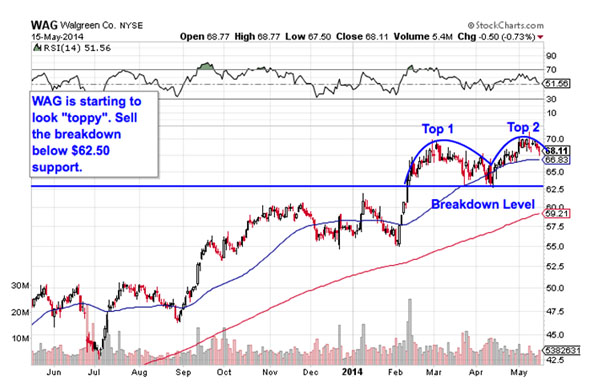
    Walgreen easily outperformed both�CVS Caremark� (NYSE: CVS  ) �and�Wal-Mart� (NYSE: WMT  ) . However,�Rite Aid� (NYSE: RAD  ) �blew all of the competitors away in terms of share performance after turning the corner on profitability in the fourth quarter of 2012.�� �

  • [By Sue Chang and Saumya Vaishampayan]

    CVS Caremark Corp. (CVS) �shares fell 0.9%. CVS said it would stop selling cigarettes and tobacco products in stores by Oct. 1. The change is estimated to cost the company $2 billion in annual revenues or 17 cents a share, but CVS said it won�� affect its 2014 per-share earnings guidance.

Top 10 Cheap Companies To Watch In Right Now: S&P Smallcap 600(PH)

Parker Hannifin Corporation manufactures fluid power systems, electromechanical controls, and related components worldwide. Its Industrial segment offers pneumatic and electromechanical components, and systems; filters, systems, and instruments to monitor and remove contaminants from fuel, air, oil, water, and other liquids and gases; connectors that control, transmit, and contain fluid; hydraulic components and systems for builders and users of industrial and mobile machinery and equipment; critical flow components for process instrumentation, healthcare, and ultra-high-purity applications; and static and dynamic sealing devices. This segment sells its products to original equipment manufacturers (OEMs) and their replacement markets in the manufacturing, transportation, and processing industries. The company?s Aerospace segment provides flight control systems and components, including hydraulic, electrohydraulic, electric backup hydraulic, electrohydrostatic, and electro -mechanical components for precise control of aircraft rudders, elevators, ailerons, and other aerodynamic control surfaces. It also provides electronics thermal management heat rejection systems, and single-phase and two-phase heat collection systems for radar, ISAR, and power electronics. This segment markets its products primarily to OEMs in the commercial, military, and general aviation markets, as well as to end users. Its Climate and Industrial Controls segment offers systems and components primarily for use in the mobile and stationary refrigeration, and air conditioning industry; and in fluid control applications in various industries, such as processing, fuel dispensing, beverage dispensing, and mobile emissions. This segment serves OEMs and their replacement markets. Parker-Hannifin Corporation markets its products through direct-sales employees, independent distributors, wholesalers, and sales representatives. The company was founded in 1918 and is headquartered i n Cleveland, Ohio.

Advisors' Opinion:
  • [By Ben Levisohn]

    But don’t just buy any company, DeBlase says. Instead, focus on those that have EPS momentum, which has generated outperformance in 10 of the past 11 years, DeBlase says. As a result, investors should prefer Terex (TEX), her top pick, and Agco (AGCO), which she rates Outperform. John Deere (DE) and Parker Hannifin (PH) get tarred with Underweight ratings.

  • [By Stephen Rosenman]

    Can you really take a company's yearly guidance seriously? Who can predict future events a year from now? It's so hard most companies skip the ordeal. Who can blame them? So many unforeseen events can derail a company's guidance. Yet, a few daredevil companies continue giving their yearly outlook. As far as I'm concerned, that's akin to writing the front page of next year's Wall Street Journal. I've already highlighted how Caterpillar (CAT) and Parker Hannifin (PH) - two excellent companies - almost never get their yearly guidance right.

  • [By Lauren Pollock]

    Parker Hannifin Corp.'s(PH) fiscal second-quarter earnings rose 40% as the maker of motion and control equipment’s orders continued to grow and gains from a joint-venture agreement with General Electric Co.(GE) (GE) offset a costly write-down. Adjusted earnings were ahead of expectations, yet the company lowered its per-share earnings estimate for the year. Shares dropped 3.8% to $122 premarket.

Best Transportation Stocks To Watch For 2015: Wendy's/Arby's Group Inc.(WEN)

The Wendy's Company operates as a quick-service hamburger company in the United States. The company, through its subsidiary, Wendy's International, Inc., operates as a franchisor of the Wendy's restaurant system. As of December 26, 2011, the Wendy's system comprised approximately 6,500 franchise and company restaurants in the United States and the United States territories, as well as in 26 other countries worldwide. The company was formerly known as Wendy's/Arby's Group, Inc. and changed its name to The Wendy's Company in July 2011. The Wendy's Company was founded in 1884 and is headquartered in Dublin, Ohio.

Advisors' Opinion:
  • [By Ben Levisohn]

    Yesterday, McDonald’s dropped 0.3% after reporting same-store sales–and Barron’s panned the stock. Today, however, McDonald’s shares have gained 3.5% to $98.56, leaving Burger King (BKW), which has ticked up 0.3% to $27.63, and Wendy’s (WEN), which has dropped 1.1% to $9.30, in their dust.

  • [By Rick Munarriz]

    The same article singles out a QSR study that showed that the average customer had to wait 188.8 seconds at the chain's drive-thru, nearly a minute more than rival Wendy's (NASDAQ: WEN  ) .

  • [By Rich Duprey]

    Although Wendy's (NASDAQ: WEN  ) second-quarter profit was itself notable, particularly after McDonald's own rather lackluster performance, it's the news that it is selling 425 of its restaurants that was the real eye-opener.

Top 10 Cheap Companies To Watch In Right Now: Popular Inc.(BPOP)

Popular, Inc., through its subsidiaries, provides a range of retail and commercial banking products and services primarily to corporate clients, small and middle size businesses, and retail clients in Puerto Rico and Mainland United States. It offers deposit products; commercial, consumer, and mortgage loans, as well as lease finance; and finance and advisory services. The company also offers trust and asset management, brokerage and investment banking, and insurance and reinsurance services. As of December 31, 2010, it owned and occupied approximately 94 branch premises and other facilities in Puerto Rico; and 119 offices, including 20 owned and 99 leased in New York, Illinois, New Jersey, California, Florida, and Texas. Popular, Inc. was founded in 1917 and is headquartered in San Juan, Puerto Rico.

Advisors' Opinion:
  • [By Jake L'Ecuyer]

    Popular (NASDAQ: BPOP) shares tumbled 5.54 percent to $27.48 after Morgan Stanley downgraded the stock from Equal-weight to Underweight.

    Pacific Coast Oil Trust (NYSE: ROYT) down, falling 7.13 percent to $16.70 after the company priced a public offering by Pacific Coast Energy Company LP and other selling unitholders of 13,500,000 trust units at a price of $17.10 per unit.

  • [By Paul Ausick]

    Among multinationals, Sterne Agee recommends three banks. The first is Puerto Rico�� Popular Inc. (NASDAQ: BPOP). The mid-cap bank�� stock closed at $28.21 on Friday in a 52-week range of $20.31 to $34.34. Based on Sterne Agee�� 2014 price target of $40.00, Popular has an upside potential of nearly 42% and a 2014 EPS estimate of $2.90. The investment firm�� forward multiple is just 9.6, below the Thomson Reuters consensus multiple of 10.3. Popular received TARP funds in 2009 and could repay the loan in the first quarter of next year, which will give the stock a shot in the arm as well.

Top 10 Cheap Companies To Watch In Right Now: S&P GSCI(GD)

General Dynamics Corporation, an aerospace and defense company, provides business aviation; combat vehicles, weapons systems, and munitions; military and commercial shipbuilding; and communications and information technology products and services worldwide. Its Aerospace group designs, manufactures, and outfits various large and mid-cabin business-jet aircraft; provides maintenance, repair work, fixed-based operations, and aircraft management services; and performs aircraft completions for aircraft. The company?s Combat Systems group offers tracked and wheeled military vehicles, weapons systems, and munitions. Its product lines include wheeled combat and tactical vehicles; battle tanks and infantry vehicles; munitions and propellant; rockets and gun systems; and axle and drivetrain components and aftermarket parts. This group also manufactures and supplies engineered axles, suspensions, and brakes for heavy-load vehicles for military and commercial customers. The company Advisors' Opinion:

  • [By Rich Smith]

    Privately held IMT Defense Corp. and the Ordnance and Tactical Systems division of publicly traded General Dynamics (NYSE: GD  ) were both named winners of a� contract to supply M485A2 Projectile Metal Parts to the U.S. Army.

  • [By Monica Gerson]

    General Dynamics (NYSE: GD) is expected to report its Q3 earnings at $1.68 per share on revenue of $7.76 billion.

    Posted-In: Earnings scheduleEarnings News Pre-Market Outlook Markets

Top 10 Cheap Companies To Watch In Right Now: AeroVironment Inc.(AVAV)

AeroVironment, Inc. designs, develops, produces, and supports unmanned aircraft systems (UAS), and efficient energy systems for various industries and governmental agencies. Its UAS provide intelligence, surveillance, and reconnaissance, including real-time tactical reconnaissance, tracking, combat assessment, and geographic data to the small tactical unit or individual war fighter. The UAS wirelessly transmit critical live video and other information generated by their payload of electro-optical or infrared sensors directly to a hand-held ground control system, enabling the operator to view and capture images during the day or at night on a hand-held ground control unit. AeroVironment also provides spare equipment, alternative payload modules, batteries, chargers, repair services, and customer support for the UAS. In addition, the company produces industrial productivity and clean transportation solutions for commercial and government customers, develops potential clean t ransportation solutions, and performs contract engineering services; offers PosiCharge electric vehicle charging systems for industrial electric material handling fleets, electric vehicle charging systems for passenger and fleet vehicles, and power cycling and test systems for developers and manufacturers of plug-in electric and hybrid vehicles, as well as battery packs, electric motors, and fuel cells; and supplies power cycling and test systems to research and development organizations that focus on developing electric propulsion systems, electric generation systems, and electricity storage systems. It supplies its UAS primarily to the organizations within the United States department of defense. AeroVironment, Inc. was incorporated in 1971 and is headquartered in Monrovia, California.

Advisors' Opinion:
  • [By Rich Smith]

    AlamyA US Navy X-47B Unmanned Combat Air System aircraft is towed into the hanger bay aboard the aircraft carrier USS George H.W. Bush -- the first aircraft carrier to successfully catapult launch an unmanned aircraft from its flight deck. With a fiscal 2013 defense budget of nearly $614 billion, the United States is widely known to be a big spender on defense. By some estimates, U.S. defense spending accounts for nearly 60 percent of the $1.19 trillion the top 10 military powers spent on defense in 2011. In fact, our country allocates more than five times more money to defense than does its closest spending rival, China. And that's not the half of it. In the cutting-edge field of military unmanned aerial vehicles, the United States has such a huge lead over its rivals that it makes their combined UAV fleets look like a rounding error in a world that's essentially 100 percent dominated by U.S. drones. Pax Americana As The Wall Street Journal recently reported, the U.S. military commands a fleet of 429 "large drone" aircraft such as the General Atomics Predator and Northrop Grumman (NOC) Global Hawk. Meanwhile, America's smaller drones, built by everyone from Boeing (BA) to Textron (TXT) to tiny AeroVironment (AVAV), maker of the ubiquitous Raven man-portable UAV, number in the thousands. In contrast, the military of the United Kingdom, not even a U.S. rival but a close ally, boasts a fleet of precisely 10 large drones, most of which we built for them, and the rest imported from Israel. Italy has nine, France, four, and Germany has three. As a result, when allied forces need a drone to "put eyes" on a target, more often than not, they have to ring up the U.S. military to get one. Who You Gonna Call? For allied nations, that has to be embarrassing -- but it's a situation unlikely to change soon. As the Journal reports, European defense giant European Aeronautic Defence & Space (EADSY), the parent company of Airbus, is only just now beginning to test a

  • [By Abigail W., Adams]

    General Atomics' Predators and Reapers, however, are losing their status. DOD contracts for MQ-9 Reaper procurement fell from $979 million in 2013 to $411 million for 2015. Predator procurement was reduced from $28 million in 2013 to $5 million for 2015. AeroVironment's (NASDAQ: AVAV  ) RQ-11 Raven, a portable UAV capable of reconnaissance, surveillance, and target identification, were also a favorite for combat operations in Iraq and Afghanistan. The Raven, however, took an enormous hit in 2015. Procurement contracts for the compact drone dropped from $30 million in 2013 to $13 million for 2015.

Top 10 Cheap Companies To Watch In Right Now: Lionbridge Technologies Inc.(LIOX)

Lionbridge Technologies, Inc. provides language, development, and testing services. Its Global Language and Content segment provides product localization services, such as creating foreign language versions of its clients? products and software applications, including the user interface, online help systems, and documentation; and content translation services, such as translating and maintaining clients? Web-based content, eLearning courseware and training materials, technical support, and sales and marketing information. It also offers technical authoring, eLearning courseware development, and production and integration of content; and global language and content services delivery. The company?s Global Development and Testing segment develops and maintains on-premise, SaaS, and smart phone and tablet applications, as well as provides Web production services. This segment also offers various testing services under the VeriTest brand, including managed test teams, test proc ess design, test automation, functional testing, performance testing, globalization testing, and product certification. In addition, it provides specialized search relevance, online content editorial, keyword optimization, and related services. Its Interpretation segment offers interpretation services for government business and healthcare organizations that require experienced linguists to facilitate communication. It provides interpretation communication services, such as onsite interpretation, over-the-phone interpretation and interpreter testing, training, and assessment services in approximately 360 languages and dialects. The company serves the technology, mobile and telecommunications, Internet and media, life sciences, government, manufacturing, automotive, retail, and aerospace sectors in the Americas, Europe, and Asia. Lionbridge Technologies, Inc. was founded in 1996 and is headquartered in Waltham, Massachusetts.

Advisors' Opinion:
  • [By Jeff Reeves]

    Lionbridge (LIOX) is the kind of cheap, small-cap stock that investors love. This player has soared 60% in the last three months thanks to nice earnings and improving investor sentiment.

  • [By Seth Jayson]

    Calling all cash flows
    When you are trying to buy the market's best stocks, it's worth checking up on your companies' free cash flow once a quarter or so, to see whether it bears any relationship to the net income in the headlines. That's what we do with this series. Today, we're checking in on Lionbridge Technologies (Nasdaq: LIOX  ) , whose recent revenue and earnings are plotted below.

  • [By Seth Jayson]

    Calling all cash flows
    When you are trying to buy the market's best stocks, it's worth checking up on your companies' free cash flow once a quarter or so, to see whether it bears any relationship to the net income in the headlines. That's what we do with this series. Today, we're checking in on Lionbridge Technologies (Nasdaq: LIOX  ) , whose recent revenue and earnings are plotted below.

Top 10 Cheap Companies To Watch In Right Now: Kohl's Corporation(KSS)

Kohl?s Corporation operates department stores in the United States. The company?s stores offer private and exclusive, as well as national branded apparel, footwear, and accessories for women, men, and children; soft home products, such as sheets and pillows; and housewares primarily to middle-income customers. As of January 29, 2011, it operated 1,089 stores in 49 states. The company also offers on-line shopping on its Web site at Kohls.com. Kohl?s Corporation was founded in 1962 and is headquartered in Menomonee Falls, Wisconsin.

Advisors' Opinion:
  • [By Aimee Duffy]

    There aren't many people who will suggest that Kohl's Department Stores (NYSE: KSS  ) is a subversive threat to our existence as we know it. Lucky for you, dear reader, I am one of them. As our elected officials and fossil fuel lobbyists engage in never-ending battles to ensure we maintain our energy status quo, many corporations are quietly making big investments to brighten our energy future. Today I'm looking at the top 10 finishers on the Environmental Protection Agency's Green Power Partnership list. The agency ranks 50 entities, and you can see the whole list here.

Top 10 Cheap Companies To Watch In Right Now: Freeport-McMoran Copper & Gold Inc.(FCX)

Freeport-McMoRan Copper & Gold Inc. engages in the exploration, mining, and production of mineral resources. The company primarily explores for copper, gold, molybdenum, silver, and cobalt. It holds interests in various properties, located in North and South America; the Grasberg minerals district in Indonesia; and the Tenke Fungurume minerals district in the Democratic Republic of Congo. As of December 31, 2010, the company?s consolidated recoverable proven and probable reserves totaled 120.5 billion pounds of copper, 35.5 million ounces of gold, 3.39 billion pounds of molybdenum, 325.0 million ounces of silver, and 0.75 billion pounds of cobalt. The company was founded in 1987 and is headquartered in Phoenix, Arizona.

Advisors' Opinion:
  • [By Matthew Smith]

    Our bullishness of oil is well documented. The fact that we also like the NGL play in the shales should be no surprise either. These two facts are part of the reason we warmed up to Freeport-McMoRan (FCX) long-term when we did. Admittedly it was not a 'conviction buy' type of call, but we laid out the case for why we liked this diversified miner over other names and ironically the roadmap we laid out for the stock to follow is taking place. Yes, it is taking place much quicker than we anticipated but the fact of the matter is that oil and natural gas prices have remained steady as a whole and the next leg of copper and then gold seems to be taking place. The strength in copper prices has surprised us as we have watched the move over the past few weeks, but the economic data out of China has improved dramatically.

Top 10 Cheap Companies To Watch In Right Now: MEDIWARE Information Systems Inc.(MEDW)

Mediware Information Systems, Inc., together with its subsidiaries, engages in the design, development, and marketing of software solutions targeting specific processes within healthcare institutions. The company offers software systems consisting of company's proprietary application software, and third-party licensed software and hardware. It licenses, implements, and supports clinical and performance management, blood donor, and blood and biologic management products in the United States; and medication management solutions in the United States, the United Kingdom, Ireland, and South Africa. The company?s blood and biologics management solutions include HCLL Transfusion and HCLL Donor, which address blood donor recruitment, blood processing, and transfusion activities for hospitals and medical centers; BloodSafe suite of hardware and software that enable healthcare facilities to store, monitor, distribute, and track blood products; LifeTrak software for blood centers; a nd BiologiCare, a bone, tissue, and cellular product tracking software. Its medication management products comprise WORx, a pharmacy information system to manage inpatient and outpatient pharmacy operations; MediCOE, a physician order entry module; MediMAR, a nurse point-of-care administration and bedside documentation module; MediREC, which assists in achieving compliance with a Joint Commission mandate; and pharmacy management and electronic prescribing systems. The company?s performance management products include InSight software that tracks performance metrics to assist healthcare managers to manage performance. It also provides software installation and maintenance services, as well as billing and collection services to home infusion and home/durable medical equipment markets. The company markets its products primarily through its direct sales force. Mediware Information Systems, Inc. was founded in 1970 and is headquartered in Lenexa, Kansas.

Advisors' Opinion:
  • [By CRWE]

    Mediware Information Systems, Inc. (Nasdaq:MEDW) plans to acquire the assets of Indianapolis-based Strategic Healthcare Group LLC (SHG), a leading provider of blood management consulting, education and informatics solutions.

Tuesday, May 20, 2014

Chattanooga's super-fast publicly owned Internet

chattanooga high speed

Chattanooga's Electric Power Board has automatically upgraded connection speeds for customers at no charge each of the past four years.

NEW YORK (CNNMoney) Chattanooga, Tenn., may not be the first place that springs to mind when it comes to cutting-edge technology. But thanks to its ultra-high-speed Internet, the city has established itself as a center for innovation -- and an encouraging example for those frustrated with slow speeds and high costs from private broadband providers.

Chattanooga rolled out a fiber-optic network a few years ago that now offers speeds of up to 1000 Megabits per second, or 1 gigabit, for just $70 a month. A cheaper 100 Megabit plan costs $58 per month. Even the slower plan is still light-years ahead of the average U.S. connection speed, which stood at 9.8 megabits per second as of late last year, according to Akamai Technologies.

"It's really altered how we think of ourselves as a city," said Chattanooga Mayor Andy Berke. "We're a midsized, southern city -- for us to be at the front of the technological curve rather than at the tail end is a real achievement."

As federal officials find themselves at the center of controversy over net neutrality and the regulation of private Internet service providers like Comcast (CMCSA, Fortune 500) and Time Warner Cable (TWC, Fortune 500), Chattanooga offers an alternative model for keeping people connected. A city-owned agency, the Electric Power Board, runs its own network, offering higher-speed service than any of its private-sector competitors can manage.

The problem with fiber networks is that they're hugely expensive to install and maintain, requiring operators to lay new wiring underground and link it to individual homes. Since 1996, cable operators have invested $210 billion in broadband networks and other infrast! ructure, according to the National Cable and Telecommunications Association.

Since there's little competition in the broadband industry, some industry experts believe that there's little incentive for broadband providers to dramatically beef up their bandwidth and drastically improve their infrastructure.

Chattanooga's project started in 2008 with the goal of building a "smart" power grid for the city, capable of rerouting electricity on the fly to prevent outages in addition to carrying Internet traffic.

"It just didn't look like the private sector was going to bring true, high-speed connectivity to this market," EPB spokeswoman Danna Bailey said.

The city had to contend with lawsuits from Comcast and local cable operators as it worked to get the network up and running. But aided by an $111 million stimulus grant from the Department of Energy, the service was up and running by September 2009. The EPB currently has around 5,000 business customers along with 57,540 households, which have access to "triple play" bundles of video, phone and Internet service just like they would from a private provider.

"Deploying a network for telecommunications is not fundamentally different from deploying a network for power," said Benoit Felten, a broadband expert with Diffraction Analysis. "Chattanooga is the prime example of that, and it's absolutely worked."

The Federal Communications Commission recognizes the potential of muncipality-run broadband, saying earlier this year that it will push for the repeal of state and local laws supported by the cable industry that make it harder for cities to set up their own networks.

Chattanooga officials say the network has helped spark a burgeoning local tech scene and the relocation of a number of businesses, drawn by both the fast Internet and the reliability offered by the smart grid.

Hunter Lindsay, CEO of IT services firm Claris Networks, said he moved his 85-person company from Knoxville to ! Chattanoo! ga "just because of the network."

"It's logical for every city to do it, but that doesn't mean it's going to happen," Lindsay said.

Berke said Chattanooga regularly receives inquiries from other cities both in the U.S. and internationally that are interested in setting up their own networks. The city recently set up a task force to figure out how to bring the network to poorer families and make sure the community gains the maximum benefit.

"People understand that high-speed Internet access is quickly becoming a national infrastructure issue just like the highways were in the 1950s," Berke said. "If the private sector is unable to provide that kind of bandwidth because of the steep infrastructure investment, then just like highways in the 1950s, the government has to consider providing that support." To top of page

4 Value Trap Stocks to Sell Before It’s Too Late

RSS Logo Lawrence Meyers Popular Posts: 3 Preferred Stocks Yielding More Than 8%3 Covered Calls for a Cool $1,000 in IncomeHail This Taxi Dividend Stock for a 6.9% Yield   Recent Posts: 4 Value Trap Stocks to Sell Before It’s Too Late Is NRF Stock a Buy After Its 200% Jump? 3 Preferred Stocks Yielding More Than 8% View All Posts

I am primarily a value investor, so whenever I see a stock that looks cheap, I'm the first to leap at it. However, there are always traps in the Wall Street Wilderness, and these stocks have all the makings of companies that appear to be unjustly beaten down. They aren't.

iStock 000006816626XSmall 273x300 4 Value Trap Stocks to Sell Before It's Too Late

Twitter (TWTR)

I still don't understand the hype around Twitter (TWTR). I keep hearing about how the company will "leverage its platform," yet all I see at the moment is a company that generated little more than a couple hundred million dollars in advertising revenues last quarter.

It had adjusted EBITDA of only $37 million. Operation were about break-even. Yet the company is valued at … $19 billion. How? Nobody has been able to explain to me how Twitter is going to generate much profit at all. How can the market reward this company with that valuation? Value investors may get tempted by the 50% selloff thus far, but I don't see how this company is even worth $15 per share at this point.

IBM (IBM)

Best Food Stocks To Watch Right Now

I'm sorry to say it, but IBM (IBM) is not a value stock. The stock trades about 12% from its 52-week high. Yet it isn't growing at all. FY11 net income was $15.86 billion, FY12 net came in at $16.6 billion, and FY13 came in at $16.48 billion. While analysts project 8% long-term annualized earnings growth, that doesn't take into account the share buybacks the company engages in.

But hey, it's not like the company is going bankrupt, and it generates some $15 billion in free cash flow annually. So even if you slap a 9 PE on FY14 earnings of $17.88, you get fair value of $161. But more to the point, IBM is a moribund company and its competitors are racing past it. Sell.

JCPenney (JCP)

JCPenney (JCP) is still a value trap, in my opinion. The company is still struggling to reverse the damage done by previous management. JCP will report earnings on Thursday, and expectations are pathetic — a loss of $1.25 per share on a 3% increase in revenue. Comps were only 2% during the holiday season. The balance sheet remains a mess, and management is frankly just trying to stem the bleeding.

It doesn't even sound like JCP is looking for a visionary new team to transform the company anymore. The former CEO was brought back as interim CEO last year, but now it seems like he's not going anywhere. Even at $9, I would stay away. If you insist on it being a value play, at least just purchase a few calls two years out.

Groupon (GRPN)

I know I shouldn’t hate any more on Groupon (GRPN), but the company just makes it too easy. Once again, even at $6, GRPN stock is wildly overvalued. The company simply cannot turn a profit. It generates lots of revenue, to be sure — $758 million in Q1. Even that was a nice 26% increase year over year. But that still led to a loss of 6 cents per share. The big revenue increase occurred in its goods category which has margins of about 17%.

The company made its name on local sales, where margins were close to 90%. Somehow I don't think that an increase in product revenue from a category with one-fifth of those margins are going to lead to a big earnings spurt. Sell.

As of this writing, Lawrence Meyers did not hold a position in any of the aforementioned securities. He is president of Asymmetrical Media Strategies, a crisis PR firm, and PDL Broker, Inc., which brokers financing, strategic investments and distressed asset purchases between private equity firms and businesses. He also has written two books and blogs about public policy, journalistic integrity, popular culture, and world affairs. Contact him at pdlcapital66@gmail.com and follow his tweets at @ichabodscranium.


Sunday, May 18, 2014

Americans Eager to Travel After Rough Winter

Summer Travel Charles Rex Arbogast/AP NEW YORK --€" A strong case of cabin fever and a little more money to spend should inspire a greater number of Americans to hit the road this Memorial Day weekend. That's the forecast from auto club AAA, which on Friday said it expects a total of 36.1 million people to travel 50 miles or more. If that estimate holds true, it would be the largest number of people traveling during the holiday weekend since 2005. Most will drive to their vacation spots, but more people are expected to fly or take a cruise or train this year compared with a year ago, AAA said. The improving job market and a rise in disposable income are fueling the increase in holiday travel plans, AAA found in its annual survey. The desire to get out of the house after a brutally cold winter is another strong incentive to hit the road. "Thoughts of historic cold are still fresh in the minds of Americans in many parts of the country," said AAA's Chief Operating Officer Marshall Doney, in a statement. "The winter blues appear to have given Americans the travel bug." Of the total travelers, 31.8 million are expected to drive, up 1.3 percent from 31.4 million last year. Gas prices are less of a concern for drivers, since they are expected to be lower than last year's average of $3.63, thanks to rising supplies, AAA said. Airports will be busier, with 2.6 million people expected to fly this year, up 2.4 percent from last year. And 1.7 million people will take a cruise, train or bus, a 6.5 percent jump from a year ago. Travelers can expect to pay more for their getaways. Hotel rooms are likely to cost $3 more a night from last year, at an average of $169 a night, AAA said. The average cost of a round-trip plane ticket is $227, up from $215 a year ago. Car rentals will average $44 a day during the weekend, up 1 percent from a year ago. A 3.4 percent increase in personal income from last year should help cover those additional costs, the auto club said. The AAA forecast represents an 18 percent increase in travelers from 2009, the low point of the recession, when only 30.5 million Americans traveled for Memorial Day. The number has been increasing steadily since 2011. The busiest travel weekend was in 2005, when 44 million people went away. Last year, AAA said more people traveled during the Memorial Day weekend than it projected. It had expected total travel to fall nearly 1 percent from the year before to 34.8 million. But 35.5 million Americans actually traveled last year, according to a survey conducted following the holiday weekend. For its forecast, AAA works with research company IHS Global, which uses economic data to come up with its projections. A separate company, D.K. Shifflet & Associates surveys more than 50,000 households after the trips have been taken.

Saturday, May 17, 2014

Short Sellers Squeezed Out of Keurig Green Mountain

What’s the best way to fend off heavy short interest in a company’s stock? Get Coca-Cola Co.(KO) on your side.

That’s essentially what happened to Keurig Green Mountain Inc.(GMCR) The one-time target of short sellers has seen many of its skeptics abandon their bets against the stock, which has surged 58% this year.

Keurig shares rallied another 7.6% to $119.07 Tuesday after Coke, the world’s largest beverage company, said it would increase its stake in the coffee company to 16% from 10%. The increased Coke stake has given bullish Green Mountain investors confidence in the company’s long-term trajectory, while the investors betting against, or shorting, the stock continue to get squeezed out of their positions.

Hot Communications Equipment Companies To Own In Right Now

Among the most prominent investors betting against Keurig has been Greenlight Capital’s David Einhorn, who raised accounting questions about the company in a high-profile attack in 2011. In a quarterly letter to investors last month, Mr. Einhorn confirmed he was still short Keurig, noting it was the firm’s “only significant loser.”

A representative from Greenlight wasn’t immediately available for comment.

As of Monday, the percentage of Keurig shares on loan—a proxy for short-selling activity—dropped to about 3.9% of shares outstanding, according to securities-financing tracker Markit. That's down from as much as 22% in November. By comparison, the average stock in the S&P 500 has about 2.1% of its shares on loan.

Markit

Andrew Laird, an analyst at Markit, says Green Mountain’s trading is now more in-line with the average short interest of a stock in the small-cap Russell 2000, which is about 4.3% of shares outstanding.

Short sellers borrow shares to sell them in hopes of buying them back cheaper at a later date, aiming to profit from a price decline.

Coke said Tuesday that it would increase its stake in Keurig as it deepens its exposure to coffee and countertop carbonation. The move comes after it signed an agreement in February to sell its cold drinks through an at-home beverage system being developed by the fast-growing maker of the Keurig single-serve coffee maker.

Under February’s partnership, Coke acquired a 10% stake in Keurig for $1.25 billion and the option to increase its stake to as much as 16% through open-market purchases of Keurig’s common stock within 36 months. In a statement Tuesday, Coke said it had entered an accelerated purchase agreement with Credit Suisse(CSGN.VX) to acquire shares to reach that level.

Based on Keurig’s closing share price Monday of $110.71, Coke’s additional 6% stake purchase would cost roughly $1.07 billion.

–Mike Esterl contributed to this report.

Friday, May 16, 2014

Sell These 5 Toxic Stocks Before It's Too Late

BALTIMORE (Stockpickr) -- The big indices gave back nearly a full percentage point each on average yesterday, reminding investors that the sideways churn isn't over yet. Just when the broad market was grasping at new highs, it got swatted lower in a move much like the one back at the start of April.

>>5 Big Stocks to Trade for Gains This Summer

That prolonged sideways price action is frustrating, but it's not particularly ominous -- unless you own some toxic names in your portfolio. Frankly, the biggest gains this year haven't come from picking the right stocks; they've come from not owning the wrong ones.

Today, we're taking a closer look at five large-cap names that look toxic in May.

Just to be clear, the companies I'm talking about today aren't exactly junk. By that, I mean they're not next up in line at bankruptcy court. But that's frankly irrelevant; from a technical analysis standpoint, sellers are shoving around these toxic stocks right now. For that reason, fundamental investors need to decide how long they're willing to take the pain if they want to hold onto these firms in the weeks and months ahead. And for investors looking to buy one of these positions, it makes sense to wait for more favorable technical conditions (and a lower share price) before piling in.

>>5 Stocks Insiders Love Right Now

For the unfamiliar, technical analysis is a way for investors to quantify qualitative factors, such as investor psychology, based on a stock's price action and trends. Once the domain of cloistered trading teams on Wall Street, technicals can help top traders make consistently profitable trades and can aid fundamental investors in better planning their stock execution.

So without further ado, let's take a look at five toxic stocks you should be unloading.

PowerShares QQQ Trust


First up is "The Qs": the PowerShares QQQ Teust (QQQ), a $40 billion ETF that tracks the performance of the Nasdaq 100 Index. QQQ has been a popular trading vehicle for the last couple of years, primarily because it's tracked the Nasdaq's performance during a span where high-momentum tech names have worked really well. But since March, the opposite has been true, and this ETF has corrected to the tune of 5%.

Materially lower ground could be in the cards now, thanks to a classical bearish setup in shares. Here's what to look out for.

QQQ is currently forming a textbook head and shoulders top, a bearish reversal pattern that indicates exhaustion among buyers. The setup is formed by two swing highs that top out at approximately the same level (the shoulders), separated by a higher high (the head). The sell signal comes on a move through QQQ's neckline, which is right at $84. Put more simply, if QQQ can't catch a bid above $84, it becomes a sell.

It's important to remember that this stock's setup is conditional. It doesn't become toxic until that $84 neckline gets violated. In the meantime, this big index ETF has ample opportunities to change its course. That said, investors should at least be keeping a close eye on that $84 level in May. If shares break down though it, look out below.

Fluor


$12 billion engineering services firm Fluor (FLR) is another name that's looking toxic in May. In fact, shares have been forming a bearish price setup since all the way back in January, making it a longer-term trade with equally long-term trading implications when it triggers. That means FLR could be in store for a pretty rough summer.

Fluor is currently forming a descending triangle setup, a bearish trade that's formed by horizontal support below shares (in this case at $74), and downtrending resistance to the topside. Basically, as FLR bounces in between those two technically-significant price levels, it's getting squeezed closer and closer to a breakdown below that $74 price floor. When that happens, it's time to be a seller.

Momentum, measured by 14-day RSI, adds some extra evidence to Fluor's downside setup. Our momentum gauge has been making lower highs going all the way back to last September. Since momentum is a leading indicator of price, that doesn't bode well for FLR's longs right now.

FedEx

We're seeing the exact same setup in shares of FedEx (FDX). After rallying more than 38% amid strength in the transports sector, a descending triangle is indicating that FDX might be getting ready to roll over. The support level to watch is $130 – if FedEx breaks down below it, it's time to sell the shipping giant.

Why the significance at $130? Whenever you're looking at any technical price pattern, it's critical to keep buyers and sellers in mind. Patterns like head and shoulders setups and descending triangles are a good way to quickly describe what's going on in a stock, but they're not the reason it's tradable. Instead, it all comes down to supply and demand for shares.

That horizontal $130 support level in FDX is the spot where there's previously been an excess of demand for shares; in other words, it's a price where buyers have been more eager to step in and buy shares at a lower price than sellers were to sell. That's what makes a breakdown below support so significant -- the move means that sellers are finally strong enough to absorb all of the excess demand at the at price level.

For the best risk/reward tradeoff, wait for the next move lower before selling FDX.

Agilent Technologies

You don't have to be an expert technical trader to figure out what's going on in shares of measurement equipment manufacturer Agilent Technologies (A); this chart is about as simple as they get. Agilent is currently forming a textbook downtrending channel, and that makes this a toxic name in May.

The setup is formed by a pair of parallel trend lines: a resistance line above shares, and a support line below them. Those two lines on the chart provide traders with the high-probability range for Agilent's shares to stay within. When it comes to trend channels, up is good and down is bad; it's really as simple as that. And with shares moving lower off of trend line resistance for a fourth time since January, now's the time to sell this toxic stock.

Another indicator, relative strength (not to be confused with RSI), is the side signal that's pointing to downside in Agilent in May. Relative strength has been trending lower since February, indicating that this $18 billion stock is continually underperforming the broad market this year.

Walgreen

Last up is Walgreen (WAG), a name that's shown investors some outstanding performance this past year. In the trailing 12 months, Walgreen has rallied more than 39%, outperforming the S&P 500 by more than double. But after climbing higher for so long, WAG is starting to look "toppy" this month. Here's how to trade it.

Walgreen is currently forming a double top setup, a bearish reversal pattern that looks just like it sounds. The double top is formed by a pair of swing highs that max out at approximately the same price level. The sell signal comes when the trough that separates the two highs gets violated. For WAG, that breakdown level is right at $62.50, a price level that shares are moving back down toward this week.

Like the other conditional trades on this list, until the breakdown below $62.50 happens, downside isn't a high probability trade -- yet. When and if $62.50 gets taken out, though, you'll want to be a seller. If you decide to short WAG on the break, keep a protective stop at the 50-day moving average.

To see this week's trades in action, check out the Toxic Stocks portfolio on Stockpickr.

-- Written by Jonas Elmerraji in Baltimore.


RELATED LINKS:


>>3 Stocks Breaking Out on Big Volume


>>5 Rocket Stocks to Beat a Sideways Market


>>5 Tech Stocks Entering Breakout Mode

Follow Stockpickr on Twitter and become a fan on Facebook.

At the time of publication, author had no positions in stocks mentioned.

Jonas Elmerraji, CMT, is a senior market analyst at Agora Financial in Baltimore and a contributor to

TheStreet. Before that, he managed a portfolio of stocks for an investment advisory returned 15% in 2008. He has been featured in Forbes , Investor's Business Daily, and on CNBC.com. Jonas holds a degree in financial economics from UMBC and the Chartered Market Technician designation.

Follow Jonas on Twitter @JonasElmerraji