Sunday, May 27, 2018

This Rare-Disease Biotech Scores an Important Win

After the FDA approved Palynziq (formerly pegvaliase) for use in adults with phenylketonuria (PKU), a rare genetic disease, this week,�BioMarin Pharmaceutical�(NASDAQ:BMRN)�is in a great position to add hundreds of millions of dollars in new revenue to its top line. BioMarin already markets one PKU therapy, Kuvan, so it should be able to hit the ground running. Is BioMarin a stock worth buying now?

What is PKU?

A genetic disease caused by an inability to break down an amino acid, PKU can result in the toxic buildup of phenylalanine in the brain, particularly if patients consume�protein-rich foods or foods containing aspartame, an artificial sweetener.

A person holds a rubber stamp in his hand with the word approved printed on it.

IMAGE SOURCE: GETTY IMAGES.

As phenyalanine levels increase to dangerous levels, it can cause irreversible brain damage, developmental delays, and neurological problems, including seizure. It's a severe condition, but it's relatively rare. Globally, it impacts about 50,000 people.�

Because PKU is debilitating, all 50 states in the U.S. require PKU screening at birth. There's no cure for PKU, so treatment involves a lifelong dietary restriction that's very hard for patients to comply with. In�some PKU patients,�BioMarin's Kuvan, a pharmaceutical version of BH4, a natural substance that reduces phenyalanine levels by breaking it down, is also prescribed.

Currently, only about 12% of PKU patients, most of whom are children, take Kuvan, yet it's BioMarin's second best-selling product, with $408 million in sales in 2017.

Reaching more PKU patients

Palynziq is a potent drug, and because of this, it's initially only being approved for use in adults with PKU. BioMarin believes roughly 12,000 adults in the U.S. could benefit from using its newly approved drug and that its worldwide addressable market totals about 33,000 people.�

An enzyme replacement approach, Palynziq substitutes the deficient phenylalanine enzyme in PKU with a version of the enzyme phenylalanine ammonia lyase, which can break down�phenyalanine.�

Immune responses, including anaphylaxis, occurred in Palynziq's trials, so the FDA approval includes a REMS program, and the dosing of it in patients will be titrated over four to six months to improve tolerability and so that patients can take the lowest effective dose. In trials, 11% of patients discontinued Palynziq because of adverse reactions.�

While safety concerns can't be ignored, Palynziq is a first-of-its-kind solution for adult patients, and its efficacy could allow BioMarin to treat substantially more PKU patients than Kuvan. According to BioMarin's management, Palynziq has billion-dollar per year peak sales potential.

Initially, BioMarin's focus will be converting the 200 adult PKU patients that participated in Palynziq's trials into commercial users. Once that's done, the company will focus on the 2,300 adult Americans who are being treated in clinics, and then, it will embrace a strategy to reach the roughly 7,500 patients who are diagnosed with PKU, but who haven't sought out treatment at a clinic for at least two years.

BioMarin expects that Palynziq will be available commercially in late June at an average expected cost of $192,000 per patient per year. At that price, the company would generate $38.4 million in annual sales if it converts the 200 trial participants into regular patients and $480 million per year if it also successfully gets Palynziq prescribed to the 2,300 people being treated in clinics.�

Pricing isn't likely to be as high outside of the U.S., but the addressable market there is bigger, so an EU approval would also be meaningful.�EU regulators accepted Palynziq's application for approval earlier this year, and overall, management says there are 15,000 adult PKU patients in Europe and Turkey, including 4,900 who are being treated in clinics.

What's on deck

Kuvan's use in children should continue to make it a top-seller for the company, at least until generics become available. BioMarin has licensed rights to two generic drugmakers, and generic Kuvan could arrive�as soon as October 2020.

In the meantime, BioMarin will enjoy a dominant position in PKU that will help BioMarin take another step toward achieving profitability. Following Palynziq's OK, BioMarin has now won approvals for seven drugs. In 2017, the company's global revenue was $1.3 billion, so the potential to add hundreds of millions of dollars in new sales would significantly move the needle.�

BMRN Revenue (Annual) Chart

BMRN Revenue (Annual) data by YCharts.

In addition to improving progress toward profit, the additional revenue will also come in handy in support of BioMarin's R&D pipeline, including a potentially game-changing PKU gene therapy.�BioMarin hopes to begin human trials for a gene therapy that could restore the production of the missing enzyme in PKU patients in 2019.�The potential for a one-and-done gene therapy in PKU would significantly disrupt the market.

Overall, the impact Palynziq may have on BioMarin's financials in the next year or two, and the opportunity longer-term to create even better treatments for PKU, make it an interesting stock that I think is worth buying in growth portfolios.

Saturday, May 26, 2018

Hot Canadian Stocks To Watch Right Now

tags:PMT,NRG,MMM,COP,PPL,WFC,

Canadian Prime Minister Justin Trudeau promised he would implement massive changes to Canada marijuana laws. And when he does, it will create a new and booming economy.

If Canada places a "sin tax" of 50% on recreational marijuana sales, the country could make $5 billion annually, according to a CIBC World Markets report.

Currently, only medical marijuana is legal in Canada.

But an overwhelming amount of Canadians support legalizing recreational marijuana…

According to a poll conducted in the summer of 2016, 43% of the 1,000 Canadians surveyed supported legalizing recreational marijuana. Also, 26% of those surveyed somewhat supported legalizing recreational marijuana.

Only 17% were opposed, and 9% were somewhat opposed.

Hot Canadian Stocks To Watch Right Now: PennyMac Mortgage Investment Trust(PMT)

Advisors' Opinion:
  • [By Stephan Byrd]

    Pennymac Mortgage Investment (NYSE:PMT) – Equities researchers at Wedbush lifted their Q1 2019 earnings per share estimates for shares of Pennymac Mortgage Investment in a research note issued to investors on Thursday, May 10th. Wedbush analyst J. Weaver now anticipates that the real estate investment trust will post earnings per share of $0.36 for the quarter, up from their previous estimate of $0.34. Wedbush also issued estimates for Pennymac Mortgage Investment’s Q2 2019 earnings at $0.43 EPS, Q3 2019 earnings at $0.43 EPS, Q4 2019 earnings at $0.52 EPS and FY2019 earnings at $1.74 EPS.

  • [By Stephan Byrd]

    Pennymac Mortgage Investment (NYSE:PMT) shares reached a new 52-week high and low on Monday . The company traded as low as $18.60 and last traded at $18.62, with a volume of 19306 shares changing hands. The stock had previously closed at $18.50.

Hot Canadian Stocks To Watch Right Now: NRG Energy Inc.(NRG)

Advisors' Opinion:
  • [By Jon C. Ogg]

    NRG Energy Inc. (NYSE: NRG) was started with a Buy rating and�assigned a $37 price objective (versus a $33.15 close) at Merrill Lynch.

    Oasis Petroleum Corp. (NYSE: OAS) was reiterated as Overweight and the target price was raised to $17 from $13 at Morgan Stanley.

  • [By Ethan Ryder]

    DTE Energy (NYSE: DTE) and NRG Energy (NYSE:NRG) are both utilities companies, but which is the superior investment? We will contrast the two businesses based on the strength of their earnings, institutional ownership, profitability, valuation, risk, dividends and analyst recommendations.

Hot Canadian Stocks To Watch Right Now: 3M Company(MMM)

Advisors' Opinion:
  • [By Paul Ausick]

    The second-worst Dow stock so far this year is General Electric Co. (NYSE: GE), which is down 16.3%. That is followed by Walmart Inc. (NYSE: WMT), down 15.6%, 3M Co (NYSE: MMM), down 12.8%, and Johnson & Johnson (NYSE: JNJ), down 8.9%. With the exception of Walmart, which is spending some $15 billion to acquire a majority stake in India’s Flipkart, the five worst performers all cut their losses last week, with GE adding about 3.6% to its share price.

  • [By Travis Hoium]

    Shares of industrial giant 3M Co (NYSE:MMM) had a rough start to the day, falling 8.8% Tuesday, after reporting earnings for the first quarter of 2018. Results were better than expected, but guidance was pulled back a bit and that was enough to send investors running for the hills. The decline seemed to pick up the pace as the day went on and at 1:15 p.m. EDT shares were down 8.6% and near their low for the day.

  • [By Chris Lange]

    3M Co. (NYSE: MMM) is scheduled to reveal its fourth-quarter results on Thursday. The consensus earnings estimate is $2.03 per share, on revenue of $7.87 billion. Shares were trading at $248.18 as the week came to a close. The 52-week trading range is $173.55 to $249.00.

  • [By ]

    In fact, top dividend-paying companies like Procter & Gamble (NYSE:PG), Johnson & Johnson (NYSE:JNJ), and 3M (NYSE:MMM) have consistently converted 15% or more of their revenues into free cash flows (FCF). Combined, the three companies generated nearly $173 billion in revenues in 2017. That's a lot of money, and a good chunk of it is going into shareholders' pockets. That's why these money-minting dividend stocks deserve your attention.

  • [By Ethan Ryder]

    Cadinha & Co. LLC increased its stake in 3M (NYSE:MMM) by 84.6% in the 1st quarter, according to its most recent 13F filing with the Securities & Exchange Commission. The institutional investor owned 6,150 shares of the conglomerate’s stock after acquiring an additional 2,818 shares during the quarter. Cadinha & Co. LLC’s holdings in 3M were worth $1,350,000 at the end of the most recent reporting period.

  • [By Lisa Levin] Companies Reporting Before The Bell United Technologies Corporation (NYSE: UTX) is estimated to report quarterly earnings at $1.51 per share on revenue of $14.62 billion. The Coca-Cola Company (NYSE: KO) is expected to report quarterly earnings at $0.46 per share on revenue of $7.31 billion. Caterpillar Inc. (NYSE: CAT) is projected to report quarterly earnings at $2.07 per share on revenue of $11.93 billion. Verizon Communications Inc. (NYSE: VZ) is expected to report quarterly earnings at $1.11 per share on revenue of $31.22 billion. Lockheed Martin Corporation (NYSE: LMT) is estimated to report quarterly earnings at $3.42 per share on revenue of $11.28 billion. The Sherwin-Williams Company (NYSE: SHW) is projected to report quarterly earnings at $3.15 per share on revenue of $3.94 billion. Biogen Inc. (NASDAQ: BIIB) is expected to report quarterly earnings at $5.92 per share on revenue of $3.15 billion. 3M Company (NYSE: MMM) is estimated to report quarterly earnings at $2.52 per share on revenue of $8.26 billion. JetBlue Airways Corporation (NASDAQ: JBLU) is projected to report quarterly earnings at $0.2 per share on revenue of $1.75 billion. Eli Lilly and Company (NYSE: LLY) is expected to report quarterly earnings at $1.13 per share on revenue of $5.49 billion. Harley-Davidson, Inc. (NYSE: HOG) is estimated to report quarterly earnings at $0.88 per share on revenue of $1.25 billion. Corning Incorporated (NYSE: GLW) is expected to report quarterly earnings at $0.3 per share on revenue of $2.50 billion. Centene Corporation (NYSE: CNC) is projected to report quarterly earnings at $1.88 per share on revenue of $13.28 billion. The Travelers Companies, Inc. (NYSE: TRV) is estimated to report quarterly earnings at $2.77 per share on revenue of $6.75 billion. Wipro Limited (NYSE: WIT) is expected to report quarterly earnings at $0.07 per share on revenue of $2.16 billion. PACCAR Inc (NASDAQ: PCAR) is projected to

Hot Canadian Stocks To Watch Right Now: ConocoPhillips(COP)

Advisors' Opinion:
  • [By ]

    As things stand right now, analysts anticipate that at least some Iranian oil will come off the market as a result of the sanctions. That lost output would further tighten an oil market that suddenly has little margin for error thanks to red-hot demand and tame supply growth. That's the recipe for higher oil prices and could make top-tier U.S. oil stocks Anadarko Petroleum (NYSE:APC), Devon Energy (NYSE:DVN), and ConocoPhillips (NYSE:COP) big winners in the coming years.

  • [By The Ticker Tape]

    TD Ameritrade clients appeared to take some profits in multiple names during the period. Oil companies were popular sells with ConocoPhillips (NYSE: COP), BP  PLC (ADR) (NYSE: BP), National-Oilwell Varco Inc. (NYSE: NOV), and Transocean LTD (NYSE: RIG) all net sold. Oil prices traded near three-year highs on higher global demand and possible OPEC-led production cuts. COP and BP both traded at multi-year highs, while NOV and RIG reached 52-week highs, enticing clients to take profits in all four names. Alcoa Corp. (NYSE: AA) traded at levels not seen since before the financial crisis following proposed tariffs on steel and aluminum, and was net sold. For the third month in a row, Facebook, Inc. (NASDAQ: FB) was net sold after CEO Mark Zuckerberg testified before Congress regarding the misuse of user data and a beat on earnings.

  • [By Chris Lange]

    The number of ConocoPhillips (NYSE: COP) shares short rose slightly to 21.33 million from the previous level of 21.01 million. Shares were trading at $64.79, within a 52-week range of $42.27 to $71.71.

  • [By John Bromels]

    If you're looking for a compelling oil and gas industry investment, why not start at the top? The biggest U.S. oil and gas company,�ExxonMobil�(NYSE:XOM), had been outperforming the biggest U.S. independent oil and gas exploration and production company,�ConocoPhillips�(NYSE:COP), for years as the oil price downturn hurt profits.

  • [By Zacks]

    Moreover, BP opened 100 retail sites in the country in 2017 and plans to open 1,400 more by 2021. The largest publicly traded oil company, ExxonMobil Corporation (NYSE: XOM) opened its gas stations in Mexico in December, while one of the world's biggest independent oil producers – ConocoPhillips (NYSE: COP) – showed interest in Mexico, post-reform.

Hot Canadian Stocks To Watch Right Now: PPL Corporation(PPL)

Advisors' Opinion:
  • [By Paul Ausick]

    PPL Corp. (NYSE: PPL) posted a 52-week low of $30.74 after closing Tuesday at $30.76. The 52-week high is $40.20. Volume was about 3.2 million, about 25% below the daily average of around 4.5 million shares. The electric utility company had no specific news.

  • [By Paul Ausick]

    PPL Corp. (NYSE: PPL) posted a 52-week low of $30.81 after closing Friday at $31.13. The 52-week high is $40.20. Volume was about 3.5 million, about 25% below the daily average of around 4.5 million shares. The electric utility company had no specific news.

  • [By Paul Ausick]

    PPL Corp. (NYSE: PPL) dropped about 1.7% Tuesday to post a new 52-week low of $30.44 after closing at $30.95 on Friday. Volume was around 4.1 million about 10% below the daily average of around 4.6 million. The company had no specific news.

  • [By ]

    If this is, indeed, the case, investors have a handful of high quality names at attractive prices to choose from. One that has popped up on my radar is PPL Corporation (NYSE: PPL).

  • [By Shane Hupp]

    Pembina Pipeline (TSE:PPL) (NYSE:PBA) had its target price lowered by CIBC from C$53.00 to C$51.00 in a research report sent to investors on Monday morning.

  • [By Paul Ausick]

    PPL Corp. (NYSE: PPL) traded down about 1.3% Thursday to post a new 52-week low of $26.65 after closing Wednesday at $27.01. The stock’s 52-week high is $40.20 Volume was about 35% below �the daily average of around 7 million shares. The company had no specific news.

Hot Canadian Stocks To Watch Right Now: Wells Fargo & Company(WFC)

Advisors' Opinion:
  • [By ]

    Wells Fargo & Co. (WFC) hasn't had a shortage of scandals and embarrassment over the past few years. It's resulted in management changes, $1 billion fees and punishments from the Federal Reserve.

  • [By ]

    Gold. The rise in gold looks solid. I'm currently long the SPDR Gold Shares ETF (GLD) . Lackluster Banks. We're seeing disappointing action in the financials. However, I continue to buy them. I'm long Bank of America (BAC) , Citigroup (C) , JPMorgan Chase (JPM) and Wells Fargo (WFC) , although I'm shorting Goldman Sachs (GS) .

    Lastly, with S&P 500 closing at 2,706, the downside risk relative to the upside reward seems to argue in favor of maintaining a net-short exposure.

  • [By Tim Melvin]

    Last Friday, the first wave of bank earnings reports hit Wall Street, when JPMorgan Chase & Co. (NYSE: JPM), Citigroup Inc. (NYSE: C), and scandal-stricken Wells Fargo & Co. (NYSE: WFC) released their first-quarter financials.

  • [By Max Byerly]

    Northern Oak Wealth Management Inc. boosted its position in Wells Fargo (NYSE:WFC) by 0.9% during the 4th quarter, according to the company in its most recent disclosure with the Securities and Exchange Commission. The fund owned 142,579 shares of the financial services provider’s stock after purchasing an additional 1,323 shares during the period. Wells Fargo comprises approximately 1.4% of Northern Oak Wealth Management Inc.’s portfolio, making the stock its 24th biggest holding. Northern Oak Wealth Management Inc.’s holdings in Wells Fargo were worth $8,650,000 at the end of the most recent reporting period.

  • [By ]

    In Tuesday's Kass Insider I remarked that there are a number of factors contributing to my cautious near-term market view:

    Narrow Market Leadership. We're back to a market that's basically led by the FAANGs -- Facebook (FB) , Amazon (AMZN) , Apple (AAPL) , Netflix (NFLX) and Google/Alphabet (GOOG) , (GOOGL) . Facebook, Amazon, Apple and Alphabet are holdings in Jim Cramer's Action Alerts PLUS. Rising Short-Term Interest Rates. The 2-year U.S. note yield is up about 1.3 basis points at 2.39%. Complacency. I'm seeing more investor complacency -- anecdotally, in the business media and elsewhere -- ever since market's main indices rallied off of their recent lows. Gold. The rise in gold looks solid. I'm currently long the SPDR Gold Shares ETF (GLD) . Lackluster Banks. We're seeing disappointing action in the financials. However, I continue to buy them. I'm long Bank of America (BAC) , Citigroup (C) , JPMorgan Chase (JPM) and Wells Fargo (WFC) , although I'm shorting Goldman Sachs (GS) .

Friday, May 25, 2018

Lam Research Valuation Model Shows 13% Upside: BUY

Investment Thesis

Analysis of the model implies Lam Research (LRCX) is currently undervalued; resolute free cash flows will increase the intrinsic value of the business in the years ahead. Volatility in the industry will create opportunities for investors to acquire shares of Lam Research.

Use Volatility To Your Advantage

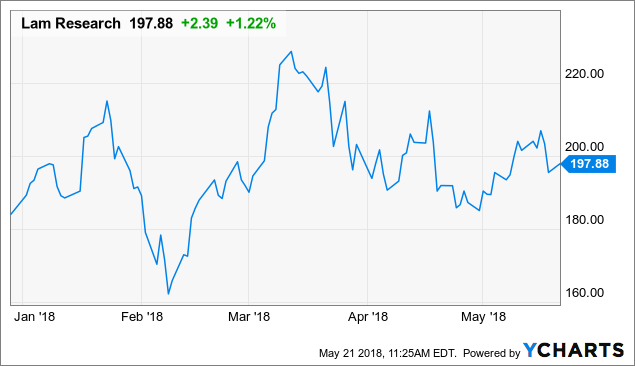
Lam Research's stock price has been on a rough ride over the past few months, but a look at the company's future cash flow suggests that the stock has upside.

The semiconductor sector remains cyclical; it is for this reason that investors are wary, many believe we are at the end of that cycle and about to head lower with sales in the sector.

Currently, Lam blows through earnings estimates almost every time but that does not seem to be enough for investors. Regardless of what numbers Lam produce, investors cannot hold the stock over the previous all-time highs.

Chart

LRCX data by YCharts

Although no grim signs of the end of a cycle are near, it still gives investors a good enough reason to sell.

Lam has been a stock for traders as of late, producing regular swings of 20%. These fluctuations are great for traders who are trading either long or short. However, long-term fundamental investing in Lam Research should not be pushed aside, investors must be able to withstand the volatility and should be using it to their advantage.

Asia Is A Key Contributor to Lam's Growth: Asian Fabrication Plants Continue To Scale

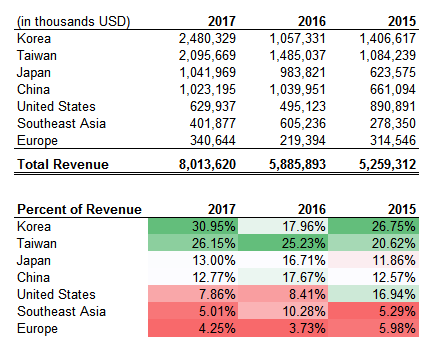
You can see above that Asia remains a core revenue driver for Lam, the U.S and Europe remain behind. Lam sells its products mainly to nations that rely heavily on cheap labor. The Asian area accounts for ~87% of revenue (as reported in the company's 10-K).

Local governments have shown great enthusiasm for supporting the semiconductor industry, and there has been a slew of policy support for related investment. - CCID Consulting, Asian Times

Lam Research creates and fabricates the tools for semiconductor manufacturing, including plasma, etch, photoresist strip, and wafer cleaning equipment.

The continued boom in the Asian semiconductor sector shows no signs of slowing. China wants to be more engaged in the chip space, this would conclusively lead to more revenue for Lam.

Several factories are set to kick off mass production this year, it's unclear how well they can perform in terms of yield and quality. Liu Kun, vice-general manager of CCID Consulting in Beijing.

Investment, in fact, is pouring into an industry which used to be dominated by the United States, South Korea, Taiwan, Japan and Europe. But that is changing rapidly. - Asian Times

Technology manufacturing, ultimately, produces jobs. The more non-government jobs that are available in an economy, the greater the GDP. China has ballooned its GDP to such heights over the years. But now, inevitably, growth is slowing. The push from the Chinese government to invest heavily in this sector could improve those GDP numbers.

Beijing will pump billions of dollars into semiconductor fabrication plants in a bid to overtake US, South Korea, Taiwan, Japan and Europe. - Asian Times

These days, everything requires chips of some sort and those chips will get cheaper very soon as competition heats up over in Asia. However, the competition in the semiconductor equipment making sector remains limited. This gives Lam Research a good opportunity to profit from such aggressive actions by the Chinese government.

Earnings Model: DCF, EBITDA, EPS

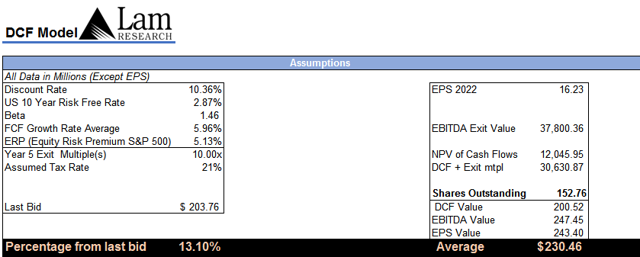
The DCF shows a valuation of ~$200, while the EBITDA valuation shows a number of $247 - also included was the 2022 EPS of $16.23. In the model, we use an averaging of the results to come up with a fitting valuation.

The averaging of these numbers produced a share price of $230.46. The number is compatible with the performance of the stock and $234.57 remains the all-time high, this reinforces the analysis and assumptions in the model.

Source: Forecasts, Michael A. Ball. Historical data, Lam Research 10-K

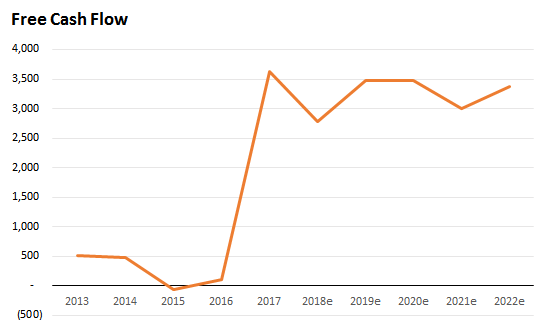
As we head forward in the year, the model will get updated and new outputs will get produced. We are only five months into the year and have more earnings to come from the sector, and this will impact the model going forward - this will more than likely produce a higher valuation number as earnings remain strong in the sector.

Capital expenditures were $49 million, which was down from $85 million in the December quarter. And as a reminder, we expect CapEx in 2018 will be higher versus 2017 levels to support manufacturing network expansion and growth in strategic R&D investments. - Lam Research Q3

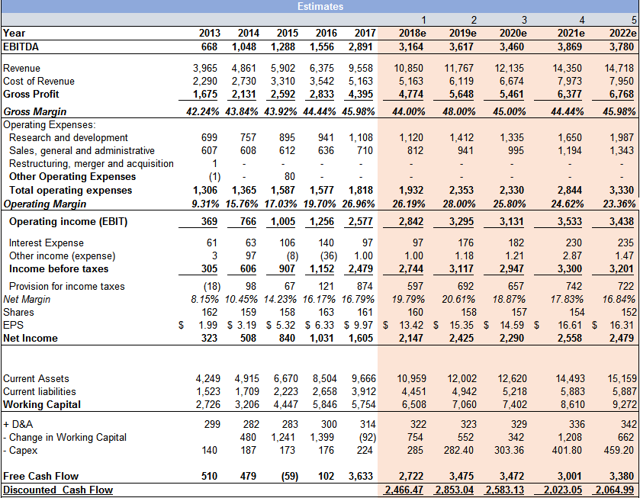
The model above has a CapEx growth of 27% in 2018. Still, we see a good amount of upside in the implied share price produced.

The 2018 forward revenue number is just slightly above the real 2018 ttm revenue number of $10.29bln. Lam's management for next quarter are projecting $3.1bln, this would take the ttm revenue up to $11.05bln. The number already tops my estimate. Nevertheless, I remain on the conservative side and will update the numbers only when we get real data. Adding such numbers to the model now could make valuations appear too frothy - the sector needs to be verified for long-term growth before we can bump up numbers to inflate valuations more.

It is more than likely that Lam will beat its guidance on sales, they have a history of doing so. Looking at past performances and estimates, Lam has a high chance of hitting targets, but still keeping valuations on the conservative side guarantees investors keep a dubious head.

Source: Forecasts, Michael A. Ball. Historical data, Lam Research 10-K

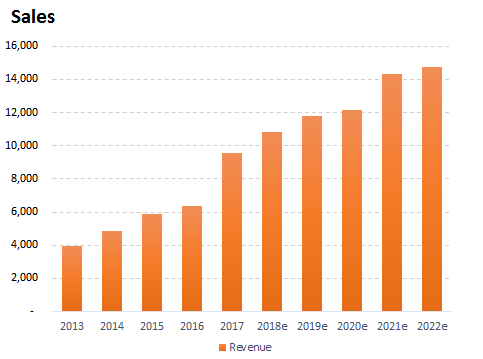
Sales should do great over the next five years. In the model for sales, we arrive at a 2022e of ~$14.7bln. The input keeps a relatively constant gross margin and growth rates average ~9%. In the model, the growth in sales does decline, starting off at 13% for 2018 and falling to 2.56% in 2022. The reasoning for the decline is to keep valuations on the conservative side as I said before. The model is merely to show a buying area and what the valuations could look like if we were to decline, it is not a target producing model as such.

Source: Forecasts, Michael A. Ball. Historical data, Lam Research 10-K

If we were to tweak the numbers and adjust the sales growth projections to that of the past, we would arrive at a higher share price estimate. Since the intentions of building this model are to support the long-term investor's current belief, it is always safer to depreciate forecasts than imply substantial growth regardless of what Wall Street is predicting. Even with such a decrease in sales growth, Lam looks undervalued; this is a good stock to own.

AI Could Boost Lam Revenue

Intel's (INTC) recent investment in Syntiant implies that a large amount of competition in the sector is leaning towards AI, and Intel investing in Syntiant would be a wise option rather than trying to compete.

Syntiant has a comparative advantage, and Intel is already introducing Syntiant to more than a dozen companies that could be using their chips. The AI market is starting to get noticed and products are becoming more mainstream.

As Lam is only one of a few semiconductor equipment makers who dominate that space, this gives Lam an advantage of being central to a potential AI boom. Lam could be significant in producing the equipment for these new and emerging companies.

Recent Upgrades

Source: Tipranks.com

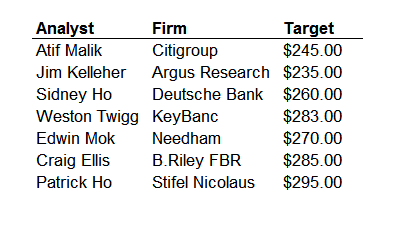
Cowen resumes Lam Research at 40% upside Lam Research +1.5% on Citi upgrade Analysts say buy the dip in Lam Research despite lower shipment guidance

All the targets issued are above current levels, this should reinforce the longer-term investor's outlook regardless of the volatility.

Analysis Conclusion

I would be happy adding Lam shares all the way up to $230 before I grow skeptical. We are still in limbo about the cycle. People are predicting the cycle will remain on an upswing, but we need to remain conservative in our valuations. Some prominent investors are saying that we are at peak cycle and they are reducing Lam shares. Once we get a confirmation about the sector, then we can issue targets and improve the model.

I predict that the cycle has a few more years left yet, but volatility will remain for a few more quarters. It would be wise to maintain a position in Lam, buying on any -3% days. We have seen such days over the last few months even after a blowout earnings - just a day or two after the stock sells off, it rebounds. The good news is that Lam is way below that $230 price the model implied.

Lam reports their next quarterly results on the 25th July and the market is expecting ~$5 EPS.

Disclosure: I am/we are long LRCX.

I wrote this article myself, and it expresses my own opinions. I am not receiving compensation for it (other than from Seeking Alpha). I have no business relationship with any company whose stock is mentioned in this article.

Thursday, May 24, 2018

Energen (EGN) Rating Reiterated by Williams Capital

Williams Capital reissued their buy rating on shares of Energen (NYSE:EGN) in a research report released on Wednesday. Williams Capital currently has a $85.00 price target on the oil and gas producer’s stock.


Several other research firms have also commented on EGN. JPMorgan Chase & Co. cut their price objective on Energen from $68.00 to $67.00 and set a sell rating on the stock in a research report on Tuesday. Bank of America raised Energen from a neutral rating to a buy rating in a research report on Thursday, May 10th. Stifel Nicolaus set a $98.00 price objective on Energen and gave the company a buy rating in a research report on Tuesday, April 24th. Zacks Investment Research raised Energen from a hold rating to a buy rating and set a $73.00 price objective on the stock in a research report on Wednesday, April 18th. Finally, Morgan Stanley raised their price objective on Energen from $73.00 to $79.00 and gave the company an overweight rating in a research report on Friday, April 20th. Two research analysts have rated the stock with a sell rating, nine have given a hold rating and fifteen have assigned a buy rating to the stock. Energen presently has an average rating of Buy and a consensus price target of $71.32.

Get Energen alerts:

Energen opened at $68.73 on Wednesday, MarketBeat reports. The company has a debt-to-equity ratio of 0.21, a quick ratio of 0.48 and a current ratio of 0.53. Energen has a 12 month low of $46.16 and a 12 month high of $71.97. The stock has a market capitalization of $6.74 billion, a price-to-earnings ratio of 40.71 and a beta of 1.43.

Energen (NYSE:EGN) last released its quarterly earnings data on Tuesday, May 8th. The oil and gas producer reported $0.81 EPS for the quarter, beating the consensus estimate of $0.77 by $0.04. Energen had a return on equity of 4.95% and a net margin of 34.60%. The company had revenue of $356.17 million for the quarter, compared to analyst estimates of $335.96 million. During the same period last year, the company posted ($0.13) earnings per share. The firm’s revenue was up 47.8% compared to the same quarter last year. equities research analysts anticipate that Energen will post 3.46 EPS for the current fiscal year.

In other Energen news, Director Jonathan Z. Cohen bought 17,500 shares of the stock in a transaction dated Friday, March 9th. The stock was bought at an average cost of $57.36 per share, for a total transaction of $1,003,800.00. Following the completion of the purchase, the director now directly owns 17,500 shares of the company’s stock, valued at $1,003,800. The acquisition was disclosed in a legal filing with the SEC, which is accessible through this hyperlink. Also, Chairman J T. Mcmanus sold 3,116 shares of the firm’s stock in a transaction dated Monday, March 26th. The shares were sold at an average price of $58.06, for a total value of $180,914.96. Following the sale, the chairman now owns 115,794 shares of the company’s stock, valued at $6,722,999.64. The disclosure for this sale can be found here. Insiders have sold 13,916 shares of company stock valued at $863,535 over the last 90 days. Insiders own 1.00% of the company’s stock.

A number of large investors have recently bought and sold shares of the stock. Municipal Employees Retirement System of Michigan grew its stake in Energen by 2.7% in the first quarter. Municipal Employees Retirement System of Michigan now owns 30,200 shares of the oil and gas producer’s stock worth $1,898,000 after purchasing an additional 800 shares in the last quarter. OppenheimerFunds Inc. grew its stake in Energen by 18.9% in the first quarter. OppenheimerFunds Inc. now owns 5,247 shares of the oil and gas producer’s stock worth $330,000 after purchasing an additional 834 shares in the last quarter. Glen Harbor Capital Management LLC grew its stake in Energen by 7.8% in the first quarter. Glen Harbor Capital Management LLC now owns 12,040 shares of the oil and gas producer’s stock worth $757,000 after purchasing an additional 868 shares in the last quarter. Mason Street Advisors LLC grew its stake in Energen by 1.9% in the first quarter. Mason Street Advisors LLC now owns 48,819 shares of the oil and gas producer’s stock worth $3,069,000 after purchasing an additional 933 shares in the last quarter. Finally, California State Teachers Retirement System grew its stake in Energen by 0.6% in the fourth quarter. California State Teachers Retirement System now owns 163,242 shares of the oil and gas producer’s stock worth $9,398,000 after purchasing an additional 952 shares in the last quarter. Institutional investors and hedge funds own 92.49% of the company’s stock.

About Energen

Energen Corporation, through its subsidiary, Energen Resources Corporation, engages in the exploration, development, and production of oil, natural gas liquids, and natural gas. The company has operations within the Midland Basin, the Delaware Basin, and the Central Basin Platform areas of the Permian Basin in west Texas and New Mexico.

Analyst Recommendations for Energen (NYSE:EGN)

Wednesday, May 23, 2018

ICO Shareholder Suits Booming, Says SEC Fintech Leader

&l;p&g;&l;img class=&q;dam-image bloomberg size-large wp-image-42335930&q; src=&q;https://specials-images.forbesimg.com/dam/imageserve/42335930/960x0.jpg?fit=scale&q; data-height=&q;640&q; data-width=&q;960&q;&g; Class action suits by Initial Coin Offering Shareholders are proliferating says SEC fintech leader. Chris Ratcliffe/Bloomberg

There are a lot of class action shareholder suits against initial coin offering issuers alleging fraud and claiming the offerings were not registered with regulators, Securities and Exchange Commission Distributed Ledger Technology Working Group Chief Valerie Szczepanik said Monday.

Distributed ledger technology encompasses blockchain and other fintech systems.

Her comments came during a day-long forum in Washington on cryptocurrency and other fintech issues hosted by the North American Securities Administrators Association.

At the session, the Commodity Futures Trading Commission and the state regulators announced a mutual cooperation agreement.

&a;ldquo;By working together, we can ensure that the rapidly evolving financial technology space has the appropriate oversight to pursue bad actors, protect market participants, and allow for market enhancing innovation, CFTC Chair Christopher Giancarlo said.

He called it a much-needed agreement to aid investors.

Speaking to the CFTC&a;rsquo;s work with the SEC and other financial regulators as well, Giancarlo boasted. &a;ldquo;I expect the bad actors in the markets will come to regret it.&a;rdquo;

&l;!--donotpaginate--&g;

He revealed that in the next several days the CFTC will issue guidance on the listing of cryptocurrency derivatives to the exchanges and clearing houses.

Stressing the need for regulators to cooperate and get up to speed on fintech, Giancarlo said smart contracts valuing themselves and calculating payments in real-time and distributed ledger technologies may come to challenge traditional market infrastructure.

CFTC LabCFTC Lead Attorney Brian Trackman told the gathering that the regulator doesn&a;rsquo;t want to get in the way of innovation.

&a;ldquo;We see (fintech) as an area of opportunity that could be transformative,&a;rdquo; Trackman said.

During the session, SIFMA First Vice President Charles De Simone called blockchain evolutionary, not revolutionary.

&a;nbsp;&l;/p&g;

Tuesday, May 22, 2018

3 Stocks for Baby Boomers to Reach Their Goals

If you're a baby boomer, that means you are either in or only a few years away from retirement. This age represents a unique time in your investment life, as you are likely going to start using your savings and investment portfolio as a source of income rather than building your nest egg. This change also means that you will need to reallocate your portfolio toward defending your wealth and generating an income stream from the principal.�

So, we asked three of our investing contributors to highlight stocks that would be well suited for a baby boomer's portfolio. Here's a brief rundown as to why they picked HP (NYSE:HPQ), ResMed (NYSE:RMD), and American Tower (NYSE:AMT).�

Woman reading a computer screen.

Image source: Getty Images.

The world's biggest PC maker

Leo Sun (HP): In late 2015, HP split into two companies: HP and Hewlett-Packard Enterprise. The former retained HP's PC and printer businesses, while the latter housed its enterprise hardware and software units.

HP's PCs and printers might seem prone to disruption from smartphones, tablets, and paperless workplaces. Nonetheless, IDC reports that HP's global PC market share still rose from 20.9% to 22.7% between 2016 and 2017 -- making HP one of just three PC makers, alongside Dell and Apple, that posted annual growth. HP attributes that growth to robust demand for its high-end laptops and 2-in-1 devices.

HP's printing business also remains strong in the commercial and consumer markets. It scaled up that business by acquiring Samsung's printing unit in late 2017, and it's diversifying its portfolio with new mobile, 3D, and even 3D metal printers.

That's why HP's Personal Systems (PC) and Printing revenues rose 15% and 14%, respectively, last quarter. Its total revenue climbed 14% to $14.5 billion -- topping estimates by $1 billion -- as its non-GAAP earnings rose 26% to $0.48 per share, beating expectations by $0.06.

Analysts expect HP's sales to rise 9% and for its earnings to climb 19% this year. Yet HP's stock still trades at just 11 times this year's earnings and pays a forward dividend yield of 2.6%. That attractive combination of a rock-solid business, low valuations, and solid dividend make HP a great investment for aging investors.

Solving a hidden problem�

Brian Feroldi (ResMed): About 25% of adults have sleep apnea, which is a condition that leads to repeated bursts of shallow (or stopped) breathing at night. Sleep apnea might sound harmless -- most people with the condition are unaware that they have it since they are sleeping when it is happening -- but it's actually a big problem. Years of untreated sleep apnea can greatly magnify the risk of developing a number of other comorbidities such as diabetes, stroke, or even a heart attack.

Medical device maker Resmed was founded nearly 30 years ago to help address this chronic problem. The company pioneered the first continuous positive airway pressure (CPAP) machine that stops�sleep apnea from happening. This device keeps the patient's airway open all night long and enables them to get a good night sleep.

While Resmed�has been hugely successful in its efforts to convince patients everywhere to adopt CPAP technology -- total sales grew 15% to�$591 million last quarter -- the company still believes that the opportunity ahead is substantial. Only about 1 out of every 7 patients who suffer from sleep apnea in developed countries wears a CPAP machine at night. The adoption rate falls to about 1 in 100 patients in many�emerging markets. These figures suggest�that Resmed's revenue should continue to grow at a robust rate as more patients and providers warm up to the�benefits of using a CPAP machine at night.�

For investors, the steady top-line gains should translate into strong profit growth in the years ahead as operating leverage and share buybacks continue to work their magic. The company's dividend yield of 1.4% act as a nice bonus too.

In total, Resmed offers investors years of double-digit profit growth potential and an income stream that is poised for growth. That's a combination that should appeal to any investor.

An income�investment to grow income over time

Tyler Crowe (American Tower): For baby boomers heading into retirement, a major focus will be to generate reliable income from their portfolio. Typically, that has meant stable high-yield stocks like utilities. While American Tower's dividend yield of 1.9% might not traditionally qualify as that high-yield dividend stock. The growth of the cell tower REIT and its payout give baby boomers income now with a lot of upside potential in the future.�

Even though it has American in the name and the U.S. makes up about 65% of operating profit, only 25% of the company's cellphone towers and telecommunications sites are in the U.S. American Tower has been investing heavily in places where cellphone adoption and penetration of 3G and 4G data networks are much lower. The expectation is that these long-life assets will generate incredibly high rates of return for years as data consumption continues on its exponential growth track and requires more and more network infrastructure equipment on towers.�

Looking at the financials, we're already�seeing the impact of these trends.�Revenue in its Latin America and EMEA (Europe, Middle East, and Africa) segments�are growing at 15% or better each year, and management has been able to steadily grow its payout 20% annually over the past five years.�

American Tower's business is pretty easy to understand, and it's not hard to see the potential out there for growing cellular and wireless data both in the U.S. and abroad. If you want a stock that has the potential to be an incredible income investment for baby boomers, then American Tower is a great place to start.�

Monday, May 21, 2018

US Gas Prices on Track for Highest Memorial Day Level in 4 Years

The average U.S. price for a gallon of regular gasoline rose by nearly five cents last week to start the new week at $2.93, according to the latest data from GasBuddy. Month over month, the price is up about 16 cents a gallon, and it is more than 56 cents a gallon higher year over year. Last month the national average was $2.763, while the year-ago average was $2.362.

Pump prices rose in all 50 states and the District of Columbia for the second consecutive time last week. Crude prices for West Texas Intermediate (WTI) remained around $71 a barrel, primarily the result of geopolitical risks such as the Venezuelan elections and the impact of the announced U.S. reimposition of sanctions against Iran.

U.S. petroleum inventories fell last week, with crude oil stockpiles down by 1.4 million barrels and gasoline inventories down by 3.8 million barrels. Crude oil exports jumped to nearly 2.6 million barrels a day last week and production topped 10.7 million barrels a day.

Patrick DeHaan, head of petroleum analysis at GasBuddy, said:

For all those that have said summer travel will be unaffected by high gas prices, we offer thousands of respondents who have strongly indicated that’s not true, especially as gas prices continue to climb. For the first time in years, the annual GasBuddy Summer Travel Survey revealed that higher prices are hurting the tradition of the summer road trip as we near a national average of $3 per gallon. It’s no shock as we continue to see higher prices in all of the nation’s 50 states. What especially rings true is that with such a big jump in prices, motorists are absolutely becoming more price conscious as they make plans this summer. High gas prices are starting to eat away at the travel plans of many, and the number will likely rise as gasoline prices appear poised to continue moving higher in the weeks ahead.

According to GasBuddy, states where prices moved most last week were: Minnesota, Illinois, Montana and Wisconsin (up eight cents), and Ohio, New Mexico, North Dakota, Kansas, Nebraska and Oklahoma (up seven cents).

States with the lowest average prices last week included: Mississippi ($2.60); Arkansas, South Carolina, Louisiana and Alabama ($2.63); Oklahoma ($2.65); Tennessee and Missouri ($2.67); and Kansas and Texas ($2.71).

The highest average prices per gallon last week were reported from California ($3.70), Hawaii ($3.64), Washington ($3.39), Nevada ($3.32), Alaska ($3.31), Oregon ($3.27), Utah ($3.18), Idaho ($3.12), Connecticut ($3.11) and Pennsylvania ($3.06).

WTI crude oil for June delivery traded up about 1% in the noon hour Monday at $71.97, while Brent for July delivery traded at $78.92. The price differential (spread) between WTI and Brent crude dipped by nine cents to $6.98 a barrel week over week.

ALSO READ: Demand for Electricity to Be Driven by Demand for Air Conditioning

Sunday, May 20, 2018

Nordic American Tanker Ltd (NAT) to Issue $0.01 Quarterly Dividend

Nordic American Tanker Ltd (NYSE:NAT) declared a quarterly dividend on Friday, April 27th, Zacks reports. Investors of record on Thursday, May 24th will be given a dividend of 0.01 per share by the shipping company on Tuesday, June 12th. This represents a $0.04 dividend on an annualized basis and a dividend yield of 1.81%. The ex-dividend date of this dividend is Wednesday, May 23rd.

Nordic American Tanker has decreased its dividend by an average of 10.5% per year over the last three years. Nordic American Tanker has a dividend payout ratio of -19.0% indicating that the company cannot currently cover its dividend with earnings alone and is relying on its balance sheet to cover its dividend payments. Research analysts expect Nordic American Tanker to earn ($0.04) per share next year, which means the company may not be able to cover its $0.12 annual dividend with an expected future payout ratio of -300.0%.

Get Nordic American Tanker alerts:

Nordic American Tanker opened at $2.21 on Friday, Marketbeat Ratings reports. Nordic American Tanker has a fifty-two week low of $2.01 and a fifty-two week high of $2.10. The company has a quick ratio of 4.10, a current ratio of 5.01 and a debt-to-equity ratio of 0.46. The firm has a market capitalization of $291.04 million, a P/E ratio of -3.11 and a beta of 0.74.

Nordic American Tanker (NYSE:NAT) last posted its quarterly earnings data on Wednesday, May 16th. The shipping company reported ($0.13) EPS for the quarter, topping the consensus estimate of ($0.20) by $0.07. Nordic American Tanker had a negative net margin of 48.82% and a negative return on equity of 9.01%. analysts predict that Nordic American Tanker will post -0.51 earnings per share for the current year.

Several research analysts have commented on NAT shares. ValuEngine raised shares of Nordic American Tanker from a “strong sell” rating to a “sell” rating in a research note on Thursday, April 19th. Zacks Investment Research raised shares of Nordic American Tanker from a “sell” rating to a “hold” rating in a research note on Wednesday, March 7th. Morgan Stanley dropped their price objective on shares of Nordic American Tanker from $2.50 to $2.25 and set an “equal weight” rating for the company in a research note on Wednesday, April 25th. Seaport Global Securities set a $3.00 price objective on shares of Nordic American Tanker and gave the stock a “hold” rating in a research note on Monday, February 12th. Finally, Credit Suisse Group dropped their price objective on shares of Nordic American Tanker from $4.00 to $2.00 and set a “neutral” rating for the company in a research note on Tuesday, February 13th. Four equities research analysts have rated the stock with a sell rating, five have issued a hold rating, one has given a buy rating and one has assigned a strong buy rating to the company’s stock. Nordic American Tanker has a consensus rating of “Hold” and an average target price of $3.32.

About Nordic American Tanker

Nordic American Tankers Limited, a tanker company, engages in acquiring and chartering double-hull tankers worldwide. It operates a fleet of 33 Suezmax crude oil tankers. The company was founded in 1995 and is based in Hamilton, Bermuda.

Dividend History for Nordic American Tanker (NYSE:NAT)

Saturday, May 19, 2018

Range Resources (RRC) Given Coverage Optimism Rating of 0.07

Media headlines about Range Resources (NYSE:RRC) have been trending somewhat positive on Saturday, Accern Sentiment Analysis reports. The research group identifies positive and negative press coverage by monitoring more than twenty million news and blog sources in real-time. Accern ranks coverage of public companies on a scale of -1 to 1, with scores nearest to one being the most favorable. Range Resources earned a daily sentiment score of 0.07 on Accern’s scale. Accern also gave media headlines about the oil and gas exploration company an impact score of 46.3371462950661 out of 100, indicating that recent press coverage is somewhat unlikely to have an effect on the stock’s share price in the near future.

Here are some of the media headlines that may have effected Accern Sentiment Analysis’s rankings:

Get Range Resources alerts: Why shareholders’ votes on methane emissions could lead to changes for drillers (bizjournals.com) Shareholders OK proposal calling on Range Resources to issue emissions management report (pionline.com) Methane shareholder resolution passes at U.S. oil and gas company (edf.org) Range shareholders approve measure to require methane report (bizjournals.com) Whirling Stocks: Range Resources Corporation (NYSE:RRC), Westport Fuel Systems Inc. (NASDAQ:WPRT), Ur-Energy … (thestreetpoint.com)

A number of equities analysts have issued reports on RRC shares. Morgan Stanley downgraded Range Resources from an “equal weight” rating to an “underweight” rating and set a $11.00 price objective for the company. in a report on Wednesday, January 24th. Credit Suisse Group decreased their price objective on Range Resources from $24.00 to $23.00 and set an “outperform” rating for the company in a report on Thursday, January 25th. Capital One downgraded Range Resources from an “overweight” rating to an “equal weight” rating in a report on Thursday, January 25th. Royal Bank of Canada decreased their price objective on Range Resources to $28.00 and set an “outperform” rating for the company in a report on Thursday, January 25th. Finally, Bank of America decreased their price objective on Range Resources from $23.00 to $22.00 and set a “neutral” rating for the company in a report on Thursday, January 25th. Five investment analysts have rated the stock with a sell rating, twelve have given a hold rating, twelve have issued a buy rating and one has given a strong buy rating to the stock. The company has an average rating of “Hold” and an average price target of $22.22.

Range Resources opened at $15.17 on Friday, Marketbeat reports. The company has a debt-to-equity ratio of 0.70, a quick ratio of 0.45 and a current ratio of 0.50. Range Resources has a one year low of $11.93 and a one year high of $25.96. The firm has a market cap of $3.85 billion, a P/E ratio of 26.16, a price-to-earnings-growth ratio of 1.03 and a beta of 0.56.

Range Resources (NYSE:RRC) last released its quarterly earnings data on Wednesday, April 25th. The oil and gas exploration company reported $0.46 EPS for the quarter, beating the consensus estimate of $0.37 by $0.09. Range Resources had a return on equity of 4.36% and a net margin of 8.24%. The company had revenue of $742.60 million for the quarter, compared to analysts’ expectations of $725.60 million. During the same period last year, the firm posted $0.25 earnings per share. Range Resources’s revenue was down 4.4% compared to the same quarter last year. equities analysts anticipate that Range Resources will post 0.93 EPS for the current fiscal year.

Range Resources Company Profile

Range Resources Corporation operates as an independent natural gas, natural gas liquids (NGLs), and oil company. It engages in the exploration, development, and acquisition of natural gas and oil properties. It holds interests in developed and undeveloped natural gas and oil leases in the Appalachian and North Louisiana regions of the United States.

Insider Buying and Selling by Quarter for Range Resources (NYSE:RRC)